Try, learn and adjust
Check traders receive usable market information
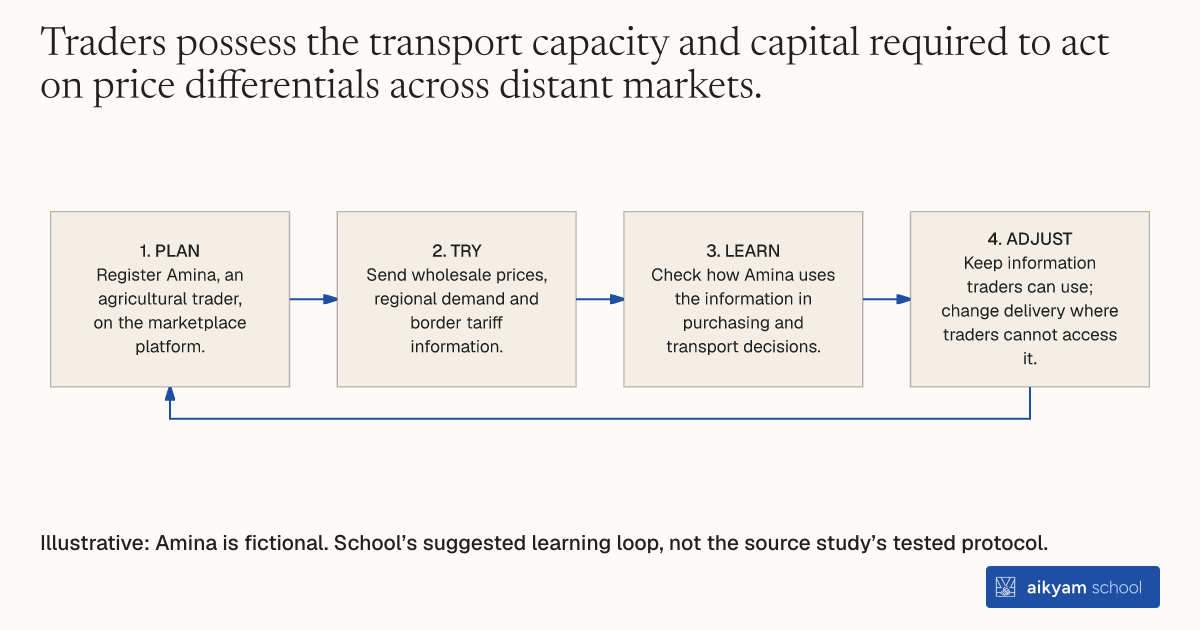
- Plan: Register Amina, an agricultural trader, on the marketplace platform.
- Try: Send wholesale prices, regional demand and border tariff information.
- Learn: Check how Amina uses the information in purchasing and transport decisions.
- Adjust: Keep information traders can use; change delivery where traders cannot access it.
Illustrative: Amina is fictional. School’s suggested learning loop, not the source study’s tested protocol.
See source →Observe information access, trading decisions and market prices; do not assume farmers gain. School suggests this learning loop; it was not tested by the source.
How
When to use
Providing agricultural price information to farmers alone often fails to eliminate market-level price dispersion due to trade fixed costs borne by intermediaries. Visiting traders face high search and transportation costs across regional markets. This method engages agricultural traders through digital marketplace platforms and price feeds to reduce trade search frictions and benefit smallholders in surplus areas.
Deploy digital marketplace platforms and tariff information services directly to regional agricultural traders and intermediaries.
- Program directors launch a digital marketplace app and trade platform tailored for agricultural intermediaries and traders.
- Field staff register local agricultural traders and market intermediaries onto the digital platform.
- System operators transmit real-time wholesale prices, regional demand data, and border tariff information to registered traders' mobile devices.
- Traders use digital marketplace data to identify crop surplus zones and evaluate regional price differences.
- Intermediary traders adjust purchasing prices and transport goods from surplus farming areas to high-demand markets.
Why it works
Providing trade platforms directly to intermediaries lowers search costs and enables traders to adjust prices in ways that benefit rural producers.
Example
In Uganda, smallholder adoption of a digital marketplace app yielded limited market access gains due to trade fixed costs, whereas trader app adoption enabled traders to adjust prices and benefit farmers in surplus areas. Similarly, on the Kenya-Uganda border, providing price and tariff information to traders reduced price dispersion at the market level as traders took advantage of regional price differences.
About the study
Participants
Smallholder farmers, informal traders, and market intermediaries in Uganda and along the Kenya-Uganda border.
Study Design
Randomized evaluations comparing digital marketplace app usage and tariff information provision targeted at traders versus farmers across regional agricultural markets.
Results
Ugandan farmers' ability to sell in new markets via a digital app was limited by trade fixed costs, whereas trader app adoption enabled price adjustments that benefited farmers in surplus areas; on the Kenya-Uganda border, providing price and tariff information to traders reduced market-level price dispersion.