Research steps
Ask about thoughts without prompting
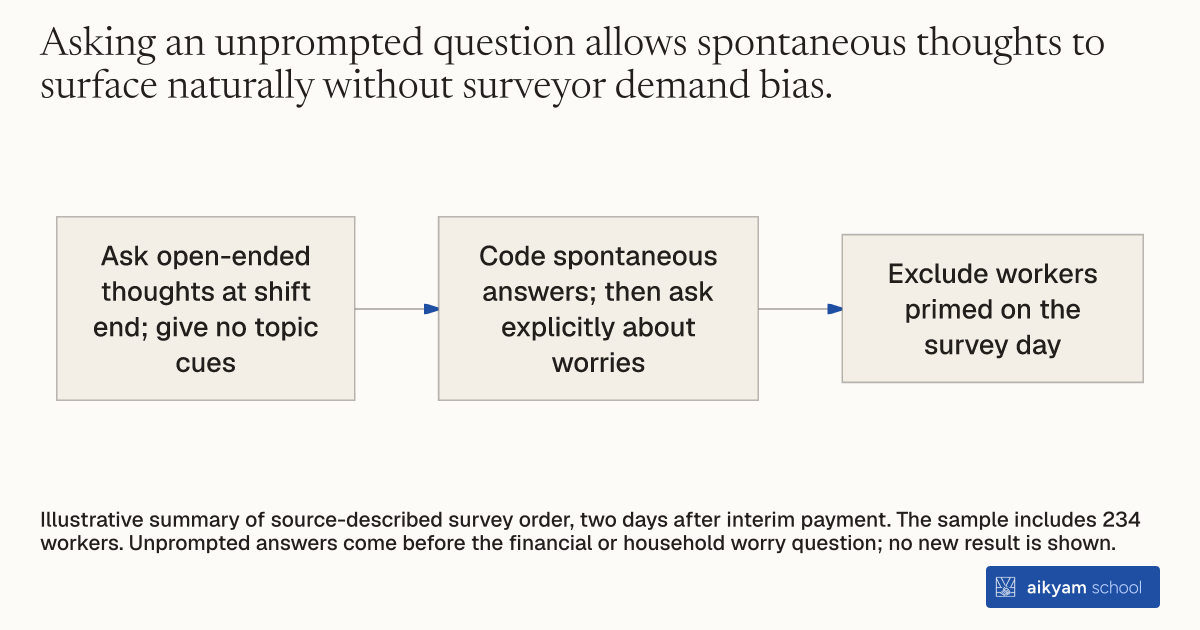
- Ask open-ended thoughts at shift end; give no topic cues
- Code spontaneous answers; then ask explicitly about worries
- Exclude workers primed on the survey day
Illustrative summary of source-described survey order, two days after interim payment. The sample includes 234 workers. Unprompted answers come before the financial or household worry question; no new result is shown.
See source →How
When to use
Measure worker task focus and financial rumination without introducing surveyor demand bias or prompting specific topics. It solves the problem of self-reported surveys artificially inserting financial worries into participants' minds during workplace evaluations. It serves behavioral researchers and organizational managers evaluating how interventions alter employee mental focus.
Measure off-task mental rumination and workplace focus by administering an unprompted, open-ended end-of-day survey after work shifts.
- Design an open-ended survey question asking workers what thoughts occurred while producing goods that day, providing no specific response categories or financial cues.
- Train enumerators to ask the question conversationally at the end of the shift and record freeform responses without reading out pre-coded options.
- Code raw responses into task-related focus versus off-task financial and household worries.
- Follow up with a second, explicit question asking specifically whether financial or household worries occurred to measure prompted awareness.
- Exclude workers who received priming interventions on that specific day to prevent confounding surveyor-induced cues.
Why it works
Comparing unprompted responses between cash-infused workers and control workers reveals whether financial strain continuously occupies background cognitive capacity during physical work.
Example
In rural Odisha, India, researchers surveyed 234 piece-rate leaf-plate makers at the end of the workday two days after a mid-contract interim wage payment. Treated workers receiving cash were 11.5 percentage points more likely to report feeling focused on their work task and 13.7 percentage points less likely to report financial rumination than control workers.
About the study
Participants
234 male casual manufacturing workers in Odisha, India (excluding workers primed on the survey day).
Study Design
Open-ended end-of-day survey administered two days post-interim payment measuring spontaneous task focus and financial rumination across control and cash-infused treatment groups.
Results
Cash-infused workers were 11.5 percentage points (15.5%) more likely to report being focused on the work task (p=0.032) and 13.7 percentage points (32.7%) less likely to report thinking about financial worries (p=0.044).