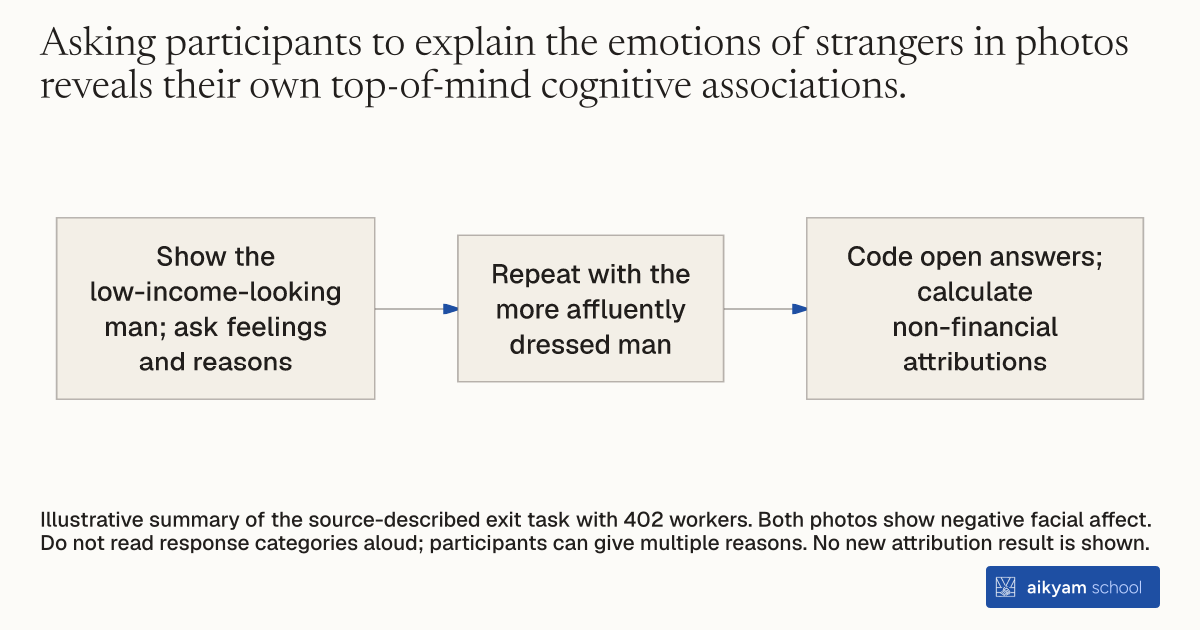
Research steps
Record interpretations of two photos
- Show the low-income-looking man; ask feelings and reasons
- Repeat with the more affluently dressed man
- Code open answers; calculate non-financial attributions
Illustrative summary of the source-described exit task with 402 workers. Both photos show negative facial affect. Do not read response categories aloud; participants can give multiple reasons. No new attribution result is shown.
See source →How
When to use
Measure what thoughts are top of mind for low-income workers without directly asking them about their own financial stress. It addresses the problem of self-report bias and surveyor prompting when evaluating psychological focus. It serves behavioral researchers and evaluators assessing how interventions alter underlying mental frames.
Evaluate participants' latent mental focus by presenting ambiguous photos of individuals and recording spontaneous emotional attributions.
- Show the participant a photo of a middle-aged man who appears low-income and exhibits negative facial affect.
- Ask the participant how the person in the picture is feeling without reading out any pre-coded options.
- Ask the participant why the person is feeling that way as an open-ended question, allowing them to list as many reasons as they choose.
- Repeat the procedure using a second photo showing a more affluently dressed man with similar facial expression.
- Code raw responses into pre-determined categories covering financial worries, health problems, household issues, or job concerns.
- Calculate the proportion of participants who attribute negative affect to reasons other than financial worries or poverty.
Why it works
Relieving personal financial strain allows individuals to contemplate non-financial explanations for negative emotions rather than reflexively focusing on money problems.
Example
During exit surveys in rural Odisha, India, researchers showed pictures of low-income and affluent men to 402 casual manufacturing workers on their final workday. Workers who received a mid-contract cash payment were 10 percentage points more likely to attribute negative affect to non-financial reasons and 9 percentage points more likely to cite reasons distinct from poverty compared to control workers.
About the study
Participants
402 male casual wage laborers aged 18 to 55 in rural Odisha, India.
Study Design
Open-ended visual attribution task administered during the endline Exit Survey comparing control workers against workers who received a mid-contract cash infusion.
Results
Cash-infused workers were 10 percentage points (30%) more likely to attribute negative affect to reasons other than financial worries (p=0.038) and 9 percentage points (62%) more likely to state reasons distinct from income or poverty (p=0.018).