In Simple Words
Think of painting only the front door of a house a local traditional color while keeping the rest of the building in its original foreign architectural style. Passersby still classify the house as foreign because the underlying structure and remaining features remain unchanged.
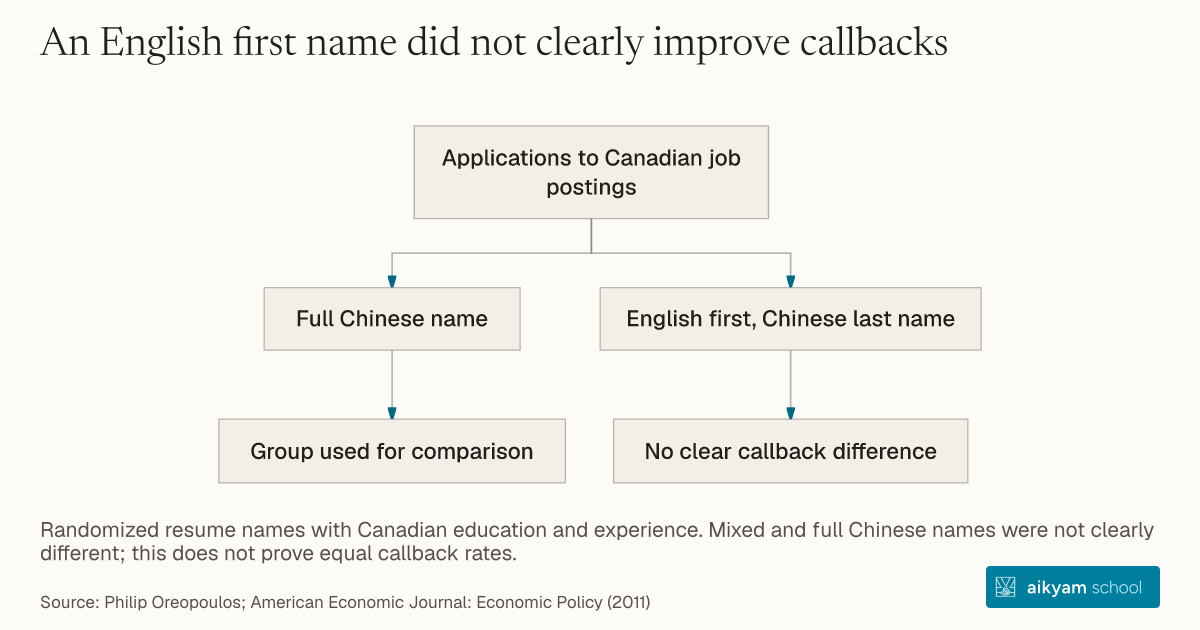
Applications to Canadian job postings
- Full Chinese name
- Group used for comparison
- English first, Chinese last name
- No clear callback difference
Randomized resume names with Canadian education and experience. Mixed and full Chinese names were not clearly different; this does not prove equal callback rates.
See source →Research question
Minority job applicants who adopt host-country English first names while retaining foreign surnames fail to generate significantly higher job interview callback rates compared to applicants retaining full foreign names.
Participants
N = 12,910 resumes submitted to 3,225 job postings across 20 occupation categories in Toronto and Montreal, Canada.
Study Design
Randomized field experiment / resume audit comparing callback rates for resumes with English first names and Chinese last names (e.g., Allen Wang) against resumes with full English names and full Chinese names.
Results
Applicants with English first names and Chinese last names received a 12.5% callback rate, which was significantly lower than applicants with full English names (15.7%, p < 0.05) and not statistically different from applicants with full Chinese names (11.3%).
Takeaway
Discontinue reliance on partial name-anglicization as a individual strategy for overcoming hiring discrimination and adopt structural resume-anonymization policies.