In Simple Words
Consider offering a budget-tracking tool to two workers: one struggling on a minimum wage with zero discretionary income, and another earning a higher salary with surplus cash available. The higher-earning worker can afford to send extra funds once given a tool to structure spending, whereas the lower-earning worker remains financially constrained regardless of budgeting support.
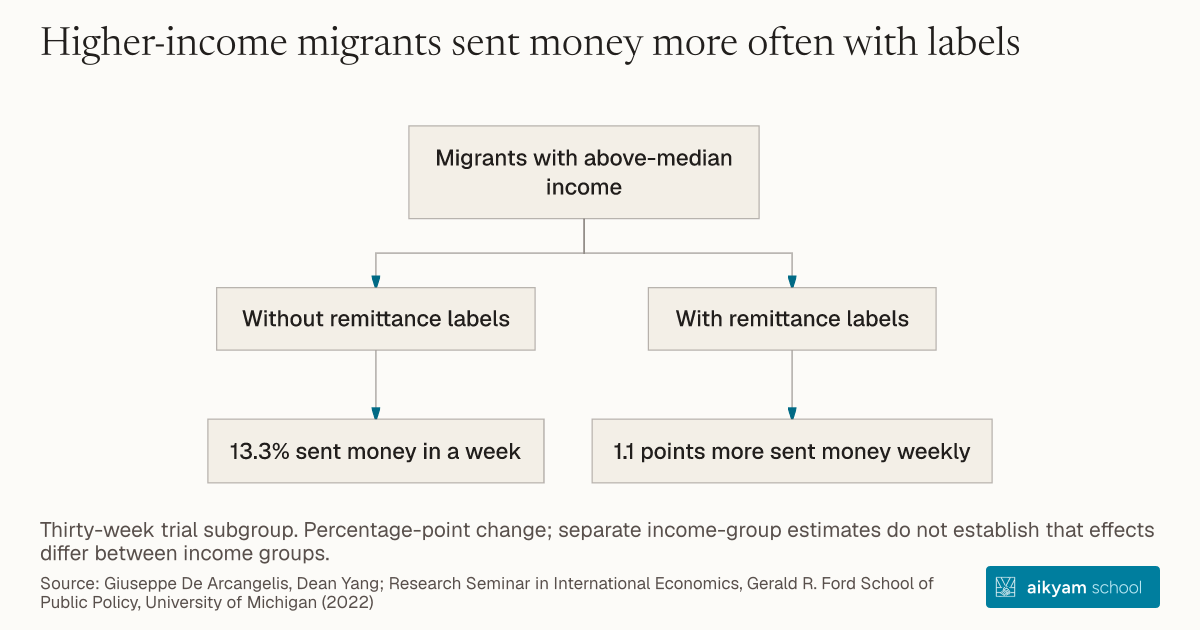
Migrants with above-median income
- Without remittance labels
- 13.3% sent money in a week
- With remittance labels
- 1.1 points more sent money weekly
Thirty-week trial subgroup. Percentage-point change; separate income-group estimates do not establish that effects differ between income groups.
See source →Research question
Interventions designed to alter financial transfer behavior may produce varying impacts depending on the sender's baseline earnings capacity. Disaggregating treatment effects across income strata is necessary to prevent misinterpreting overall null or marginal average treatment effects.
Participants
2,455 migrants with above-median monthly income (above 3,001 AED) and 1,996 migrants with below-median income out of 4,451 analyzed Filipino workers in the UAE.
Study Design
Ordinary least-squares panel regression with individual and week fixed effects evaluating weekly remittance probability, frequency, and amounts across monthly income subsamples.
Results
Access to remittance labeling significantly increased the weekly remittance probability (+1.1 percentage points, p < 0.05) and log remittance amount (+0.093, p < 0.10) for above-median income migrants, but had no statistically significant impact on below-median income migrants (+0.2 percentage points, p > 0.10).
Takeaway
Target financial behavior labeling features toward higher-income migrant segments who possess unallocated discretionary income capacity.
Source and citation
See source →Read alongside the research
Plain-English glossary
Original explanations, informed by the references below. Examples are illustrations, not data from the studies above. The research text stays unchanged.
- Median
The middle number after arranging the values from smallest to largest. If there are two middle numbers, use their average.
ExampleFor the values 2, 4 and 12, the middle value is 4. The median is 4.
NIST · Measures of location ↗Read more about median →- Baseline
The starting measurements in a study. Researchers use these to compare what participants were like at the start with what happens later.
ExampleBefore a training programme starts, researchers measure workers’ earnings. That first measurement is the baseline.
GET-IT glossary · Baseline characteristics ↗Read more about baseline →- Percentage points
The difference between two percentages.
ExampleA rise from 40% to 50% is 10 percentage points. Relative to the starting value, that is a 25% increase.
Office for National Statistics · Percentages ↗Read more about percentage points →- Statistically significant
A label used when a result passes a chosen statistical threshold, often p < 0.05. It does not show how large or useful an effect is. A result that is not statistically significant does not prove there is no effect.
ExampleA study reports p = 0.03 against a 0.05 threshold. It passes that test, but the effect could still be too small to matter.
American Statistical Association · Statement on p-values ↗Read more about statistically significant →