In Simple Words
Imagine a busy mail clerk who sorts all incoming packages arriving from overseas into an "extra inspection required" box, completely ignoring whether a package has a "pre-cleared VIP express" stamp on it. Because foreign packages arrive less often, the clerk uses one broad rule for all of them rather than taking the time to read each detailed label.
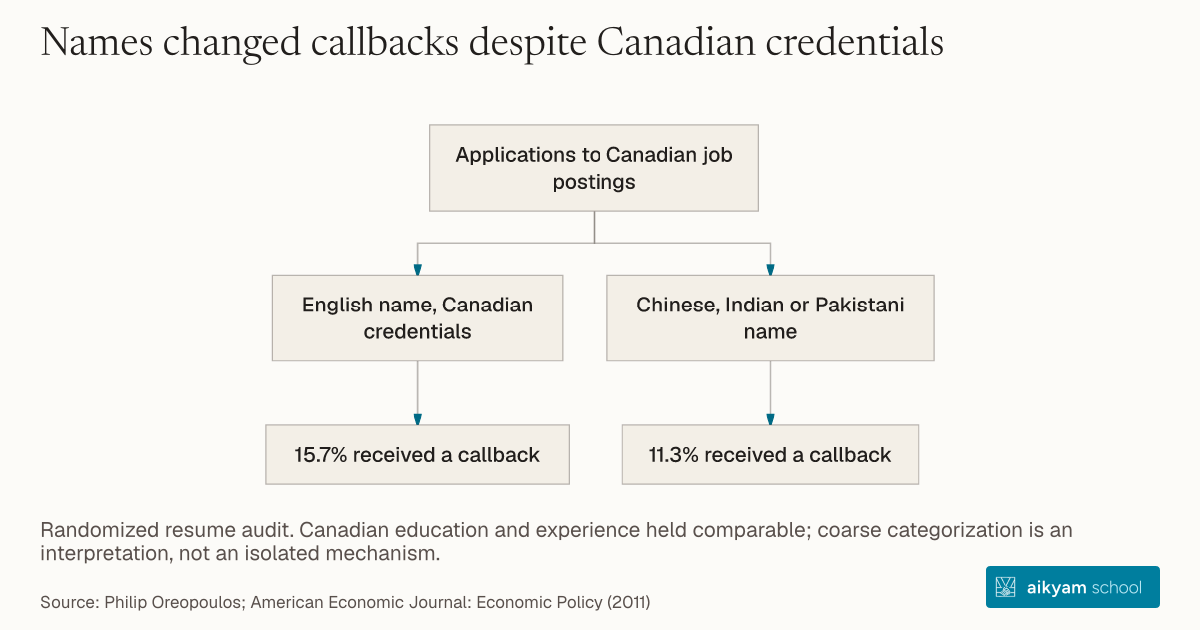
Applications to Canadian job postings
- English name, Canadian credentials
- 15.7% received a callback
- Chinese, Indian or Pakistani name
- 11.3% received a callback
Randomized resume audit. Canadian education and experience held comparable; coarse categorization is an interpretation, not an isolated mechanism.
See source →Research question
When evaluating candidate demographic groups that are less frequent or less familiar in a population, decision-makers default to broad, simplified mental buckets rather than evaluating individual nuanced qualifications. This leads hiring managers to lump all foreign-named or foreign-educated applicants together into a single lower-tier category regardless of explicit countervailing credentials on their resumes.
Participants
N = 12,910 randomized resume submissions matched with qualitative survey responses from 29 corporate recruiters in Toronto.
Study Design
Resume correspondence field experiment applying bounded rationality cognitive models (Fryer & Jackson 2008) to test interaction effects between foreign applicant backgrounds and explicit offsetting qualification signals.
Results
Recruiters consistently lumped foreign-named applicants into a single lower-evaluated group based on assumed language barriers. Even when resumes explicitly listed multi-language fluency (English, French, mother tongue), active extracurricular involvement, or high-prestige backgrounds, callback rates remained suppressed at 5.9% to 11.3% compared to 15.7% for native English-named resumes.
Takeaway
Human resource departments should institute structured, itemized evaluation rubrics for resume screening to compel evaluators to score specific individual candidate skills rather than making holistic group-based pass/fail decisions.