In Simple Words
Sustaining remedial support over two consecutive years operates like learning a foreign language; mastering fundamental vocabulary in year one allows the student to absorb sentence structure in year two, locking in permanent fluency.
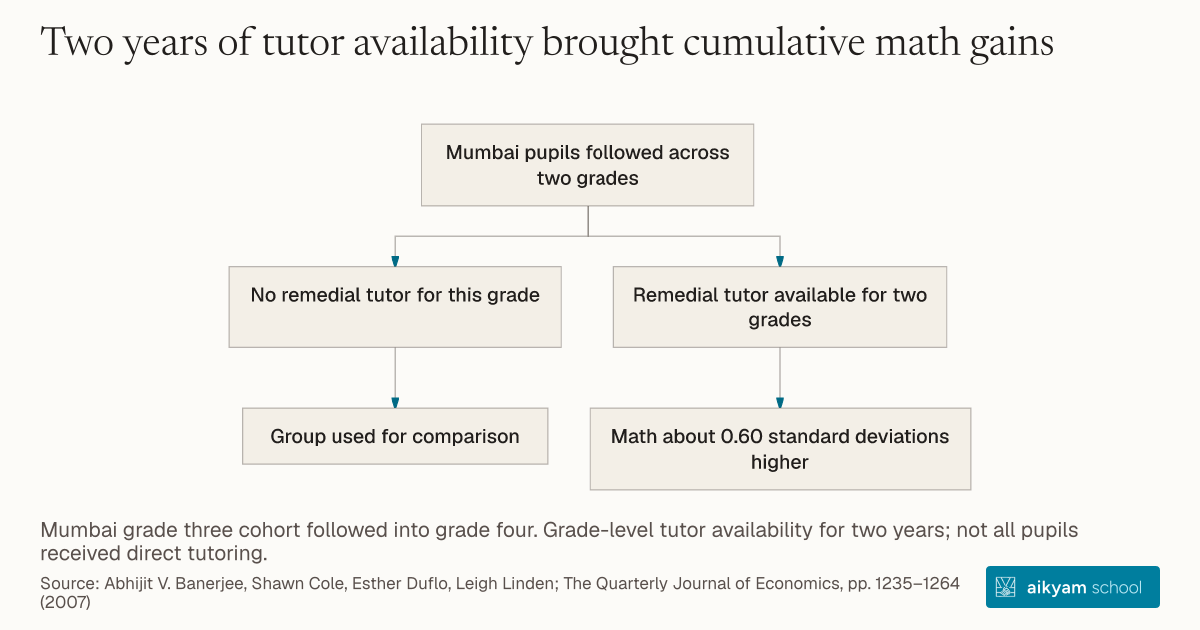
Mumbai pupils followed across two grades
- No remedial tutor for this grade
- Group used for comparison
- Remedial tutor available for two grades
- Math about 0.60 standard deviations higher
Mumbai grade three cohort followed into grade four. Grade-level tutor availability for two years; not all pupils received direct tutoring.
See source →Research question
Single-year educational interventions often produce temporary learning gains that decay rapidly unless foundational reinforcement is sustained continuously across consecutive academic grades.
Participants
N = 3,188 Grade 3 students tracked through Grade 4 over two consecutive years in Mumbai municipal primary schools.
Study Design
Longitudinal randomized controlled trial tracking individual student test score improvements from baseline pretest in Year 1 to posttest in Year 2.
Results
Two consecutive years of remedial exposure increased math test scores by 0.612 standard deviations and total test scores by 0.407 standard deviations, significantly exceeding single-year gains.
Takeaway
Structure foundational remedial instruction programs to run continuously across at least two consecutive primary grades to solidify long-term learning retention.
Source and citation
See source →Read alongside the research
Plain-English glossary
Original explanations, informed by the references below. Examples are illustrations, not data from the studies above. The research text stays unchanged.
- Longitudinal study
A study that checks the same group of people at different times. This lets researchers examine how things change over time.
ExampleResearchers ask the same workers about their wellbeing at the start, after three months and after six months.
NICE · Longitudinal study ↗Read more about longitudinal study →- Baseline
The starting measurements in a study. Researchers use these to compare what participants were like at the start with what happens later.
ExampleBefore a training programme starts, researchers measure workers’ earnings. That first measurement is the baseline.
GET-IT glossary · Baseline characteristics ↗Read more about baseline →- Randomized controlled trial
A study that uses chance, like drawing lots, to decide who receives each option being compared. Researchers compare the groups’ outcomes to estimate the effect of those options.
ExampleA lottery assigns volunteers to a training programme or a comparison group. Researchers then compare their outcomes.
GET-IT glossary · Randomized study ↗Read more about randomized controlled trial →