In Simple Words
A dominated contract is like giving $10 to a friend with instructions to burn it if you miss your daily study goal, without getting any extra money if you complete it. Although mathematically inferior to a standard contract, the threat of losing money creates immediate panic that overrides procrastination.
Observed target-setting episodes
- Firm-set targets
- Missed 8.6% to 14.1% of targets
- Voluntarily chosen targets
- Missed 2.6% of targets
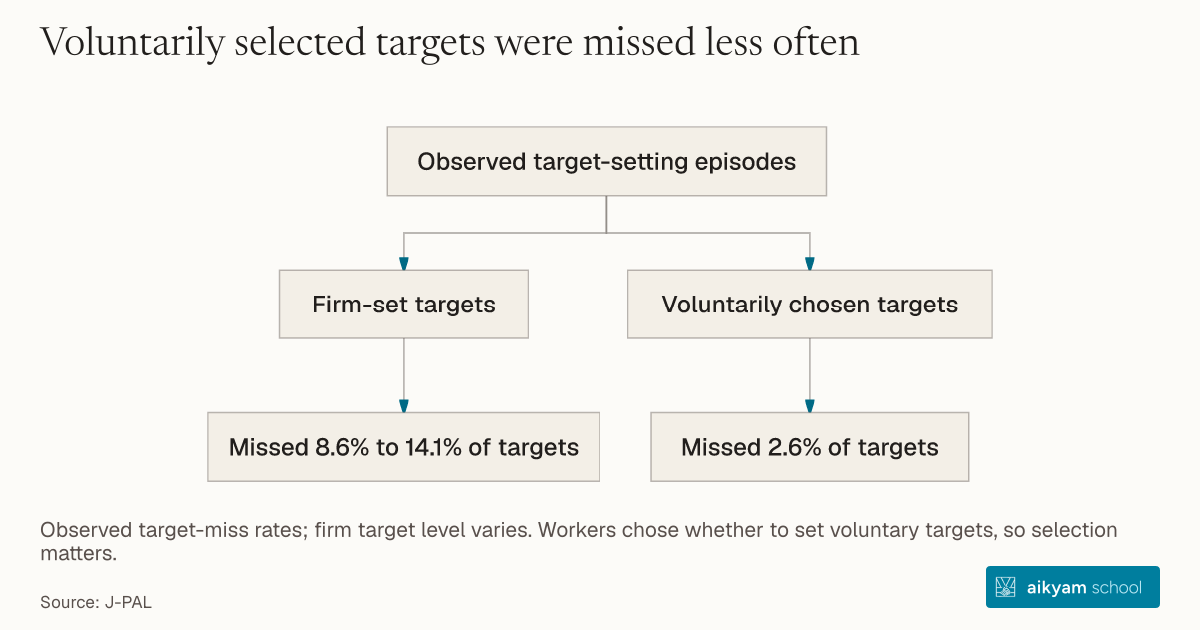
The source compares target-miss frequencies: 8.6% to 14.1% for imposed targets, depending on target level, and 2.6% for voluntarily selected targets. Voluntary selections are not an unselected worker sample. Observed target-miss rates; firm target level varies. Workers chose whether to set voluntary targets, so selection matters.
See source →Research question
Standard economic models suggest rational agents reject contracts with wage penalties for target misses without extra bonus upside, yet present-biased workers leverage them to force productivity.
Participants
N = 102 data entry workers in Mysore, India.
Study Design
Randomized Controlled Trial (RCT) comparing standard piece rates (Rs. 0.03/field) against contracts with target quotas that cut piece-rate pay by 50% (Rs. 0.015/field) for failing to meet targets.
Results
Rigid firm-imposed target penalties caused workers to miss targets 8.6% to 14.1% of the time without increasing net earnings, whereas voluntary target selection reduced the target miss rate to 2.6% and increased net worker earnings by 3%.
Takeaway
Design self-imposed penalty mechanisms rather than mandatory firm-wide quotas to leverage loss aversion without triggering high rates of costly target failure.
Source and citation
See source →Read alongside the research
Plain-English glossary
Original explanations, informed by the references below. Examples are illustrations, not data from the studies above. The research text stays unchanged.
- Randomized controlled trial
A study that uses chance, like drawing lots, to decide who receives each option being compared. Researchers compare the groups’ outcomes to estimate the effect of those options.
ExampleA lottery assigns volunteers to a training programme or a comparison group. Researchers then compare their outcomes.
GET-IT glossary · Randomized study ↗Read more about randomized controlled trial →