In Simple Words
Imagine trying to buy a used car from strangers outside your town. If a company advertises your request on a giant digital billboard, thousands of people will show up with cars, but you will be afraid to buy any of them because you cannot verify if the engines work. Conversely, if a mechanic offers to inspect cars for free, but you only look at cars in your small neighborhood, you will not find many options. Employers face the exact same double lock when hiring outside trusted acquaintance networks: they need a bigger crowd of applicants AND a trusted inspector to verify their identities before they feel safe shaking hands.
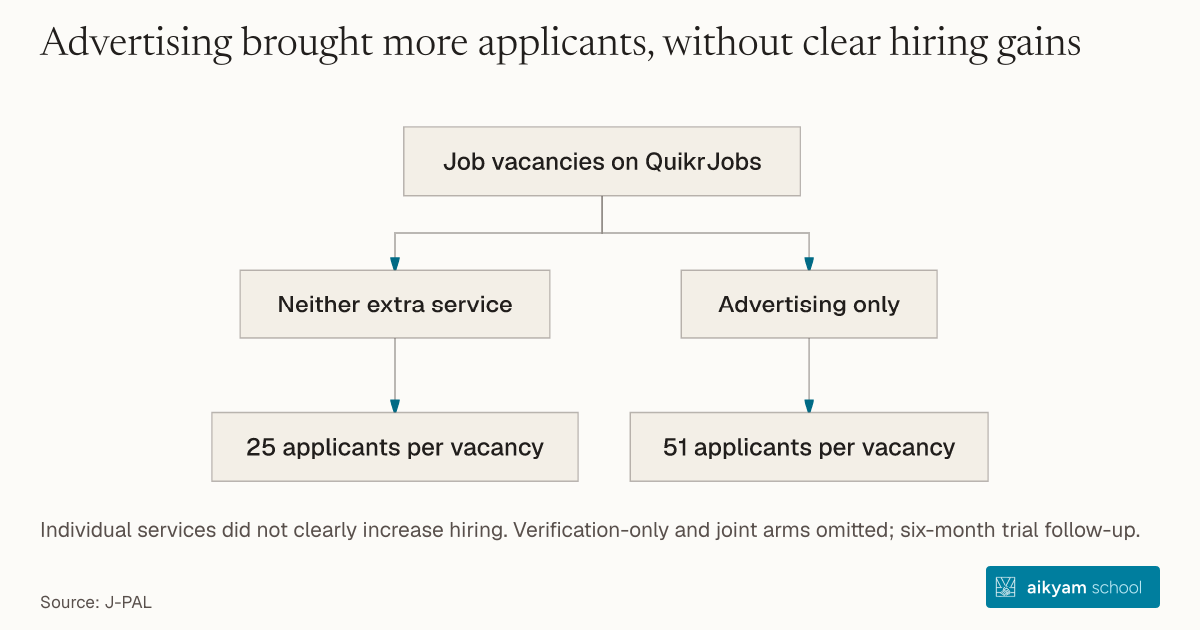
Job vacancies on QuikrJobs
- Neither extra service
- 25 applicants per vacancy
- Advertising only
- 51 applicants per vacancy
Advertising doubled applicants from 25 to 51 per vacancy, while neither individual service produced a measurable hiring increase. Individual services did not clearly increase hiring. Verification-only and joint arms omitted; six-month trial follow-up.
See source →Research question
Employers in low- and middle-income countries rely heavily on informal referral networks due to concerns about employee misbehavior and a lack of verification mechanisms. This reliance creates a dual-barrier friction: limited candidate reach combined with severe information asymmetry regarding applicant trustworthiness.
Participants
1,719 job vacancies across 1,576 firms in Bengaluru, India.
Study Design
Randomized Controlled Trial (RCT) evaluated 6 months post-intervention across four treatment arms: Scale alone (367 vacancies), Verification alone (467 vacancies), Joint Scale + Verification (470 vacancies), and Control (415 vacancies).
Results
Providing promotional advertising alone doubled applicants per vacancy from 25 to 51, but produced no measurable impact on firm hiring. Candidate identity verification alone yielded zero statistically measurable increase in hiring relative to the comparison group.
Takeaway
Deploy candidate screening and third-party credential verification tools simultaneously whenever expanding digital recruitment pools beyond internal employee referral channels.
Source and citation
See source →Read alongside the research
Plain-English glossary
Original explanations, informed by the references below. Examples are illustrations, not data from the studies above. The research text stays unchanged.
- Randomized controlled trial
A study that uses chance, like drawing lots, to decide who receives each option being compared. Researchers compare the groups’ outcomes to estimate the effect of those options.
ExampleA lottery assigns volunteers to a training programme or a comparison group. Researchers then compare their outcomes.
GET-IT glossary · Randomized study ↗Read more about randomized controlled trial →