In Simple Words
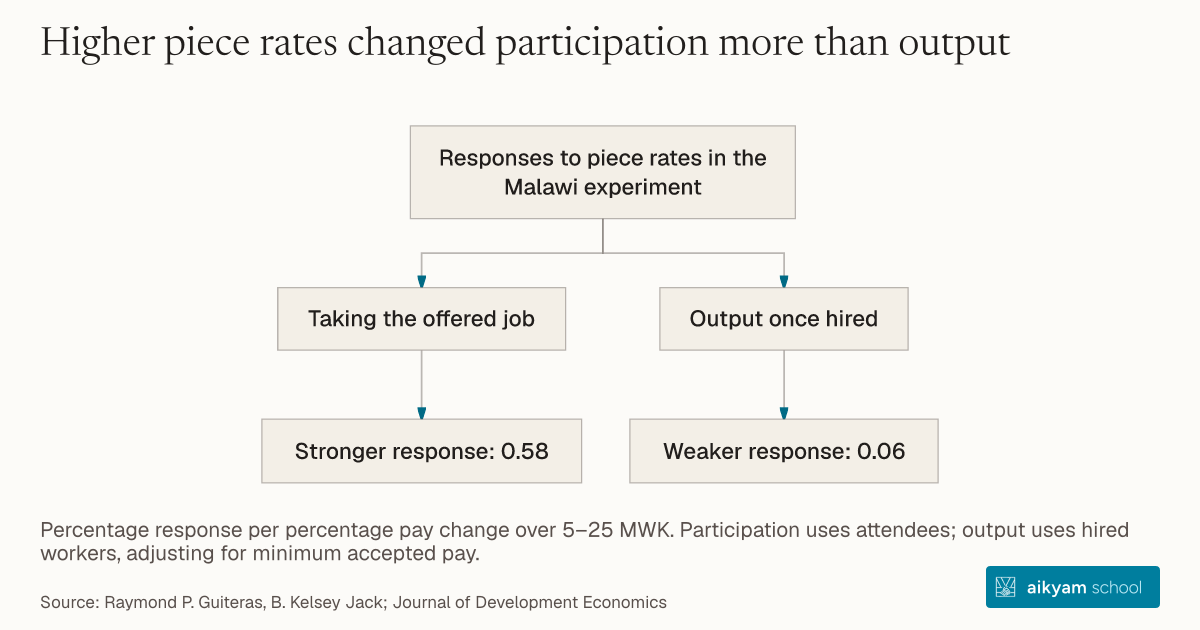
Think of opening a seasonal fruit-picking site. Increasing daily pay slightly attracts many more villagers from surrounding areas to show up for work, whereas workers already on site only pick fruit a tiny bit faster.
Responses to piece rates in the Malawi experiment
- Taking the offered job
- Stronger response: 0.58
- Output once hired
- Weaker response: 0.06
Percentage response per percentage pay change over 5–25 MWK. Participation uses attendees; output uses hired workers, adjusting for minimum accepted pay.
See source →Research question
Employers setting compensation schemes must distinguish whether wage increases primarily mobilize additional labor participation or increase individual worker productivity on the job.
Participants
N = 689 participants across 1,875 worker-days in rural Malawi.
Study Design
Randomized field experiment measuring arc elasticities of participation (hiring uptake) versus daily sorting volume across 5 piece-rate levels (5 to 25 MWK).
Results
Arc elasticity of labor participation (extensive margin) with respect to the piece rate is 0.58, whereas the elasticity of daily output quantity (intensive margin) with respect to the piece rate is only 0.06 (controlling for reservation rates).
Takeaway
Adjust piece-rate levels to expand total workforce participation rather than expecting proportional productivity gains per individual worker.