In Simple Words
Imagine scoring a gymnastics competition where one judge gives a score of 100 while everyone else scores between 5 and 10. To prevent that single extreme score from ruining the average, you cap any score higher than 10 down to exactly 10 before calculating the final result.
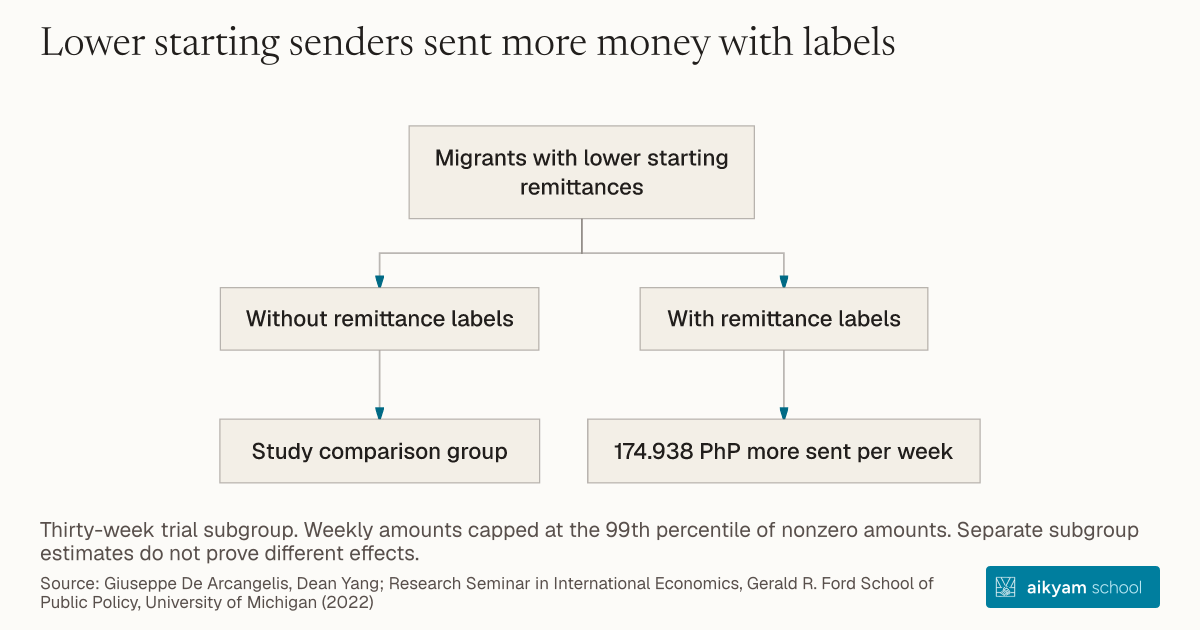
Migrants with lower starting remittances
- Without remittance labels
- Study comparison group
- With remittance labels
- 174.938 PhP more sent per week
Thirty-week trial subgroup. Weekly amounts capped at the 99th percentile of nonzero amounts. Separate subgroup estimates do not prove different effects.
See source →Research question
Financial remittance datasets frequently contain extreme high-value outliers that distort sample means and inflate standard errors in standard regression analyses. Applying top-tail truncation or winsorization preserves sample size while preventing extreme observations from driving treatment effect estimates.
Participants
137,927 weekly remittance observations across 4,451 analyzed migrant study participants.
Study Design
Capping non-zero weekly remittance amounts at the 99th percentile of the full distribution prior to panel regression estimation.
Results
Winsorization bounded weekly remittance amounts (control mean 2,338.50 PhP), stabilizing regression estimates across full sample (p = 0.81) and low-baseline subsample (+174.94 PhP, p < 0.05) specifications.
Takeaway
Cap skewed financial outcome distributions at the 99th percentile to prevent extreme top-tail outliers from distorting causal inference.
Source and citation
See source →Read alongside the research
Plain-English glossary
Original explanations, informed by the references below. Examples are illustrations, not data from the studies above. The research text stays unchanged.
- Baseline
The starting measurements in a study. Researchers use these to compare what participants were like at the start with what happens later.
ExampleBefore a training programme starts, researchers measure workers’ earnings. That first measurement is the baseline.
GET-IT glossary · Baseline characteristics ↗Read more about baseline →