In Simple Words
Imagine a fruit vendor who buys a seedling that takes two months to bear high-value fruit, but her lender demands payment every week starting on day seven. To avoid defaulting, she is forced to buy low-margin, ready-to-sell apples instead. A grace period acts like giving the vendor two months of free runway so her seedling can mature and generate a much larger harvest before repayment starts.
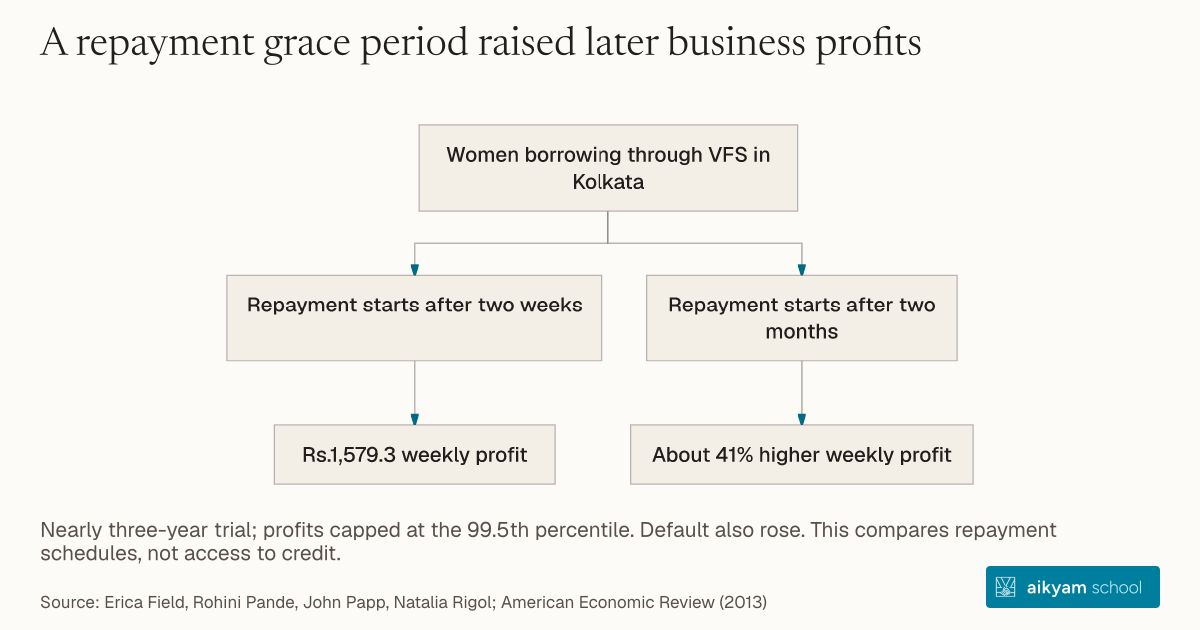
Women borrowing through VFS in Kolkata
- Repayment starts after two weeks
- Rs.1,579.3 weekly profit
- Repayment starts after two months
- About 41% higher weekly profit
Nearly three-year trial; profits capped at the 99.5th percentile. Default also rose. This compares repayment schedules, not access to credit.
See source →Research question
Classic microfinance contracts mandate repayment installments starting immediately after loan disbursement, forcing poor borrowers to maintain liquid cash reserves rather than investing in illiquid, high-return business assets. This early repayment schedule mitigates lender default risk but restricts microenterprise growth and household income generation.
Participants
N = 845 low-income female microfinance clients in 169 five-member loan groups in Kolkata, India.
Study Design
Field Randomized Controlled Trial (RCT) assigning loan groups to either a classic contract (repayment starting 2 weeks post-disbursal) or a grace period contract (repayment starting 2 months post-disbursal), with longitudinal follow-up over nearly 3 years.
Results
Grace period clients exhibited 6.0% higher short-run business investment, nearly 3 times higher rates of new business formation (2.0% control vs 4.6% treatment), 41.0% higher weekly profits, 19.5% higher monthly household income, 81.0% higher business capital, and an 11.0% to 13.0% monthly return on capital, alongside default rates that were 6 to 9 percentage points higher (5.4% default vs 1.6% control at 24 weeks).
Takeaway
Restructure microfinance loan offerings by introducing an 8-week deferral on initial installment collections for entrepreneurial clients seeking to purchase capital-intensive or illiquid inventory.
Source and citation
See source →Read alongside the research
Plain-English glossary
Original explanations, informed by the references below. Examples are illustrations, not data from the studies above. The research text stays unchanged.
- Longitudinal study
A study that checks the same group of people at different times. This lets researchers examine how things change over time.
ExampleResearchers ask the same workers about their wellbeing at the start, after three months and after six months.
NICE · Longitudinal study ↗Read more about longitudinal study →- Follow-up
Collecting more information about participants later in a study to see what has happened to them. The term can also mean the length of time researchers keep track of them.
ExampleResearchers interview the same workers three months after a programme ends. That later interview is a follow-up.
GET-IT glossary · Follow-up ↗Read more about follow-up →- Percentage points
The difference between two percentages.
ExampleA rise from 40% to 50% is 10 percentage points. Relative to the starting value, that is a 25% increase.
Office for National Statistics · Percentages ↗Read more about percentage points →- Randomized controlled trial
A study that uses chance, like drawing lots, to decide who receives each option being compared. Researchers compare the groups’ outcomes to estimate the effect of those options.
ExampleA lottery assigns volunteers to a training programme or a comparison group. Researchers then compare their outcomes.
GET-IT glossary · Randomized study ↗Read more about randomized controlled trial →