In Simple Words
Imagine two students struggling in school: one is slightly behind, while the other has missed two years of classes and lost all confidence. Offering a small attendance stipend to both students does not change much for the slightly behind student, but for the severely disconnected student, the extra financial support and structure restore their belief in future opportunities, prompting them to start attending vocational courses.
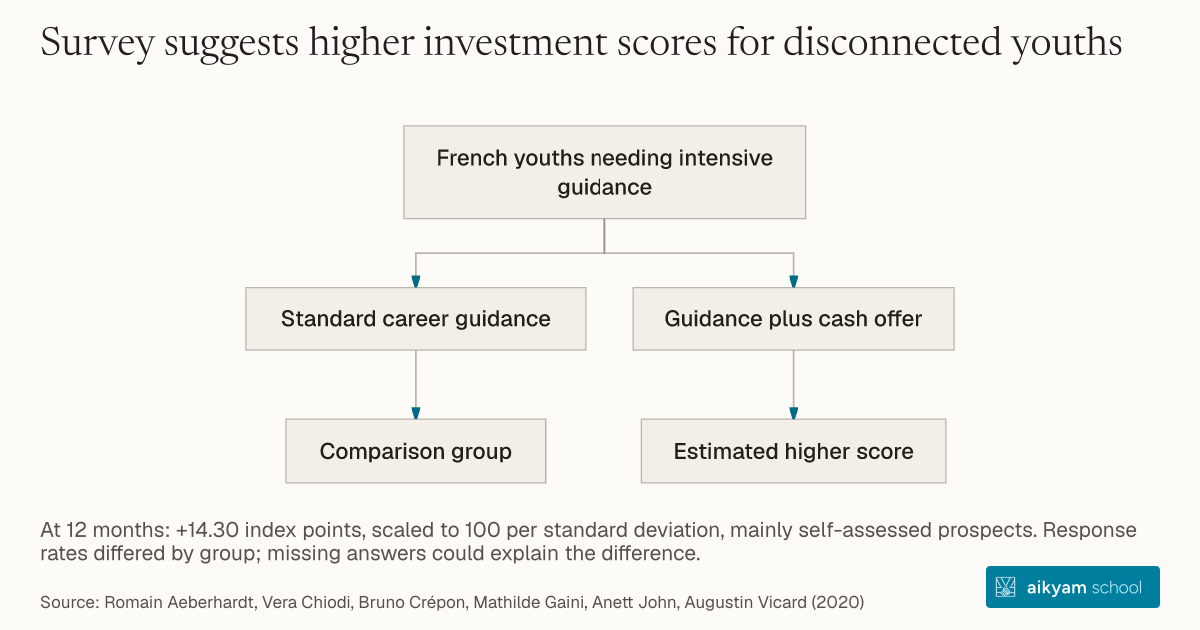
French youths needing intensive guidance
- Standard career guidance
- Comparison group
- Guidance plus cash offer
- Estimated higher score
At 12 months: +14.30 index points, scaled to 100 per standard deviation, mainly self-assessed prospects. Response rates differed by group; missing answers could explain the difference.
See source →Research question
Severely disconnected jobseekers facing deep structural barriers or long-term inactivity exhibit low baseline confidence and minimal program engagement. Standard guidance programs fail to motivate this subgroup, but combining cash transfers with counseling disproportionately increases human capital investment and career self-assessments among highly disconnected youth compared to their less disconnected peers.
Participants
Subgroup sample of N = 3,413 young jobseekers aged 18–22 across 82 French Job Youth Centers categorized by high versus low labor market disconnection (intensive vs. standard guidance track assignment).
Study Design
Randomized controlled trial (RCT) testing treatment effect heterogeneity across initial labor market disconnection status measured at enrollment.
Results
Severely disconnected jobseekers in the control group exhibited negative baseline human capital investment index scores (-11.84), but cash transfers generated a statistically significant positive effect of +14.30 points (p < 0.05; p < 0.01 for equality test across groups), driven primarily by gains in self-assessed employment prospects. Conversely, less disconnected jobseekers showed a slight negative response (-5.61 points).
Takeaway
Target conditional cash transfer interventions specifically toward severely disconnected or long-term inactive youth rather than distributing financial aid uniformly across mildly unemployed populations.
Source and citation
See source →Read alongside the research
Plain-English glossary
Original explanations, informed by the references below. Examples are illustrations, not data from the studies above. The research text stays unchanged.
- Baseline
The starting measurements in a study. Researchers use these to compare what participants were like at the start with what happens later.
ExampleBefore a training programme starts, researchers measure workers’ earnings. That first measurement is the baseline.
GET-IT glossary · Baseline characteristics ↗Read more about baseline →- Randomized controlled trial
A study that uses chance, like drawing lots, to decide who receives each option being compared. Researchers compare the groups’ outcomes to estimate the effect of those options.
ExampleA lottery assigns volunteers to a training programme or a comparison group. Researchers then compare their outcomes.
GET-IT glossary · Randomized study ↗Read more about randomized controlled trial →- Statistically significant
A label used when a result passes a chosen statistical threshold, often p < 0.05. It does not show how large or useful an effect is. A result that is not statistically significant does not prove there is no effect.
ExampleA study reports p = 0.03 against a 0.05 threshold. It passes that test, but the effect could still be too small to matter.
American Statistical Association · Statement on p-values ↗Read more about statistically significant →