In Simple Words
Think of two people playing a game of skill. The first person believes winning depends entirely on practice, so they spend all their time taking lessons and improving their technique, ignoring quick matches. The second person believes winning is just random luck, so they stop practicing and focus on playing as many quick games as possible to collect attendance rewards.
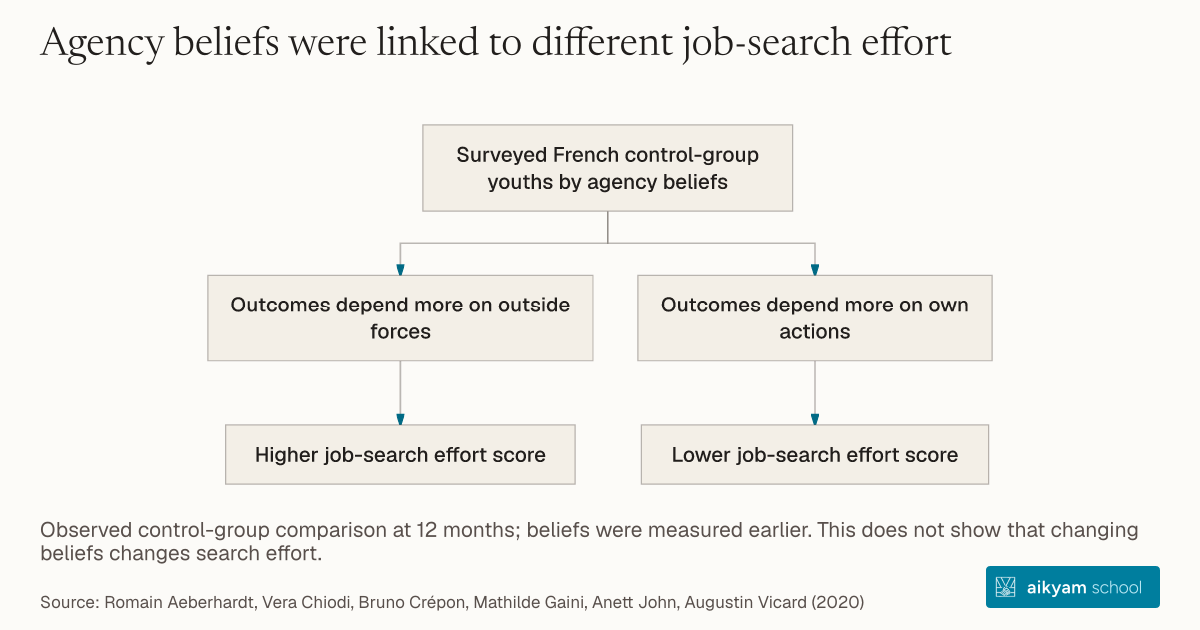
Surveyed French control-group youths by agency beliefs
- Outcomes depend more on outside forces
- Higher job-search effort score
- Outcomes depend more on own actions
- Lower job-search effort score
Observed control-group comparison at 12 months; beliefs were measured earlier. This does not show that changing beliefs changes search effort.
See source →Research question
Individual psychological beliefs regarding agency determine whether jobseekers prioritize long-term human capital investments or short-term job search. Jobseekers who believe outcomes depend on personal actions focus on skill acquisition, whereas those believing outcomes depend on external factors rely more on passive transfer payments and immediate employment search.
Participants
Subgroup sample of N = 3,270 young jobseekers aged 18–22 across 82 French Job Youth Centers split by median baseline locus of control scores.
Study Design
Randomized controlled trial (RCT) evaluating treatment effect heterogeneity across internal versus external locus of control subgroups measured via baseline survey items.
Results
Jobseekers with an internal locus of control demonstrated higher baseline human capital investment index scores (+5.16 vs -5.00) and lower search effort index scores (-4.35 vs +4.42) compared to those with an external locus of control. Cash transfers generated significant net income gains for external locus youth (€22.86 increase, p < 0.01), whereas internal locus youth actively adjusted income sources resulting in no significant net income change (€7.69, p > 0.10).
Takeaway
Assess client locus of control prior to counseling to pair external locus individuals with structured guidance and direct job matching while providing internal locus individuals with long-term skill acquisition tracks.
Source and citation
See source →Read alongside the research
Plain-English glossary
Original explanations, informed by the references below. Examples are illustrations, not data from the studies above. The research text stays unchanged.
- Median
The middle number after arranging the values from smallest to largest. If there are two middle numbers, use their average.
ExampleFor the values 2, 4 and 12, the middle value is 4. The median is 4.
NIST · Measures of location ↗Read more about median →- Baseline
The starting measurements in a study. Researchers use these to compare what participants were like at the start with what happens later.
ExampleBefore a training programme starts, researchers measure workers’ earnings. That first measurement is the baseline.
GET-IT glossary · Baseline characteristics ↗Read more about baseline →- Randomized controlled trial
A study that uses chance, like drawing lots, to decide who receives each option being compared. Researchers compare the groups’ outcomes to estimate the effect of those options.
ExampleA lottery assigns volunteers to a training programme or a comparison group. Researchers then compare their outcomes.
GET-IT glossary · Randomized study ↗Read more about randomized controlled trial →