In Simple Words
Think of a small island startup joining an international tech hub to access novel global markets, versus a large-city startup being placed in an international hub where missing local connections hinders immediate domestic execution.
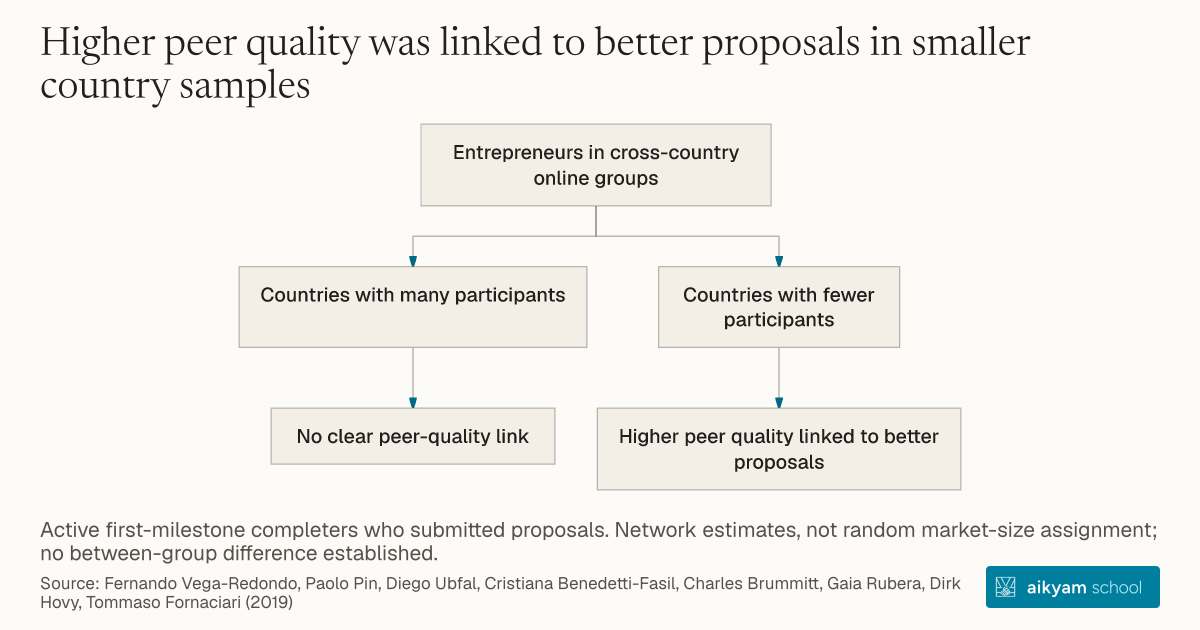
Entrepreneurs in cross-country online groups
- Countries with many participants
- No clear peer-quality link
- Countries with fewer participants
- Higher peer quality linked to better proposals
Active first-milestone completers who submitted proposals. Network estimates, not random market-size assignment; no between-group difference established.
See source →Research question
Cross-country network heterogeneity affects entrepreneurs differently depending on their home country size, as small-country entrepreneurs benefit from international exposure while large-country entrepreneurs suffer from diluted local familiarity.
Participants
N = 3,333 entrepreneurs in Large-Country Sample across 5 countries; N = 1,057 entrepreneurs in Small-Country Sample across 44 countries.
Study Design
RCT comparing Virtual-Across treatment in Small Countries (where only cross-national groups were feasible) versus Large Countries (where both Virtual-Within and Virtual-Across arms were implemented).
Results
In Small Countries, Virtual-Across interaction yields a highly significant positive network peer effect on intensive quality ($\beta = 0.476, p < 0.01$) and extensive quality ($\beta = 0.537, p < 0.01$). In Large Countries, Virtual-Across interaction yields no statistically significant peer effect on submission ($\beta = 0.014$), extensive quality ($\beta = 0.060$), or intensive quality ($\beta = 0.087$).
Takeaway
Assign entrepreneurs from smaller or less saturated markets to international heterogeneous networks to boost idea innovation, while keeping entrepreneurs from large domestic markets in nationally homogeneous groups to drive engagement.
Source and citation
See source →Read alongside the research
Plain-English glossary
Original explanations, informed by the references below. Examples are illustrations, not data from the studies above. The research text stays unchanged.
- Randomized controlled trial
A study that uses chance, like drawing lots, to decide who receives each option being compared. Researchers compare the groups’ outcomes to estimate the effect of those options.
ExampleA lottery assigns volunteers to a training programme or a comparison group. Researchers then compare their outcomes.
GET-IT glossary · Randomized study ↗Read more about randomized controlled trial →- Statistically significant
A label used when a result passes a chosen statistical threshold, often p < 0.05. It does not show how large or useful an effect is. A result that is not statistically significant does not prove there is no effect.
ExampleA study reports p = 0.03 against a 0.05 threshold. It passes that test, but the effect could still be too small to matter.
American Statistical Association · Statement on p-values ↗Read more about statistically significant →