In Simple Words
Reallocating administrative focus early in the month allows time-constrained workers to spend more time on thorough evaluation early on and adequate collection efforts later, rather than cutting corners under deadline pressure. Think of prepping ingredients before dinner service begins; early preparation improves food quality without rushing the final dish.
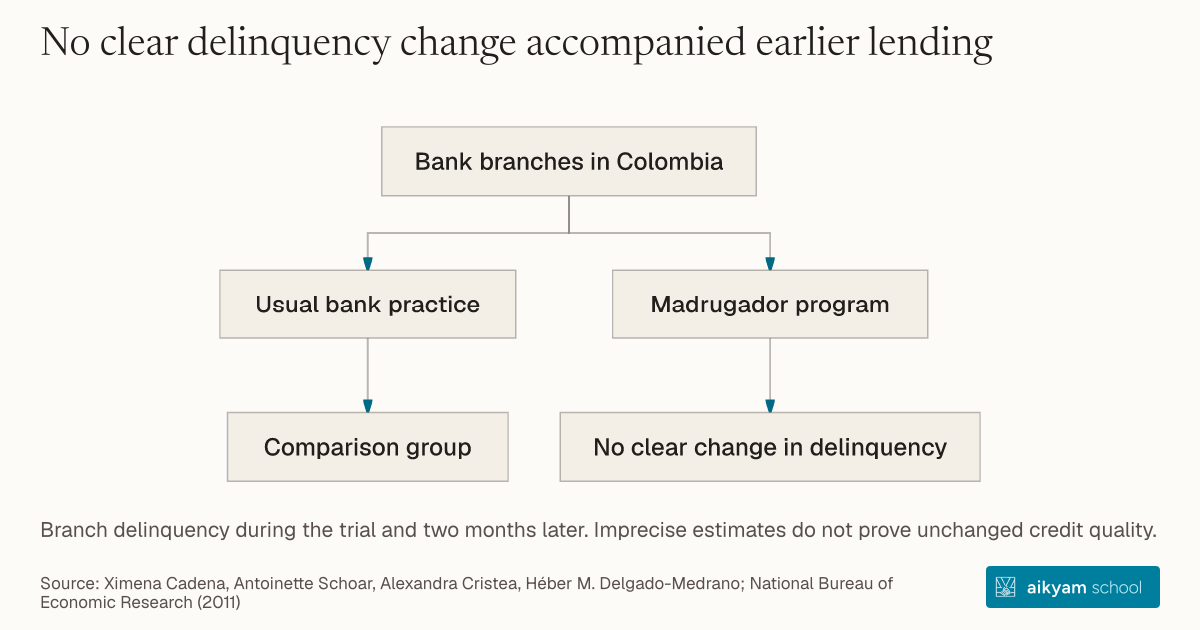
Bank branches in Colombia
- Usual bank practice
- Comparison group
- Madrugador program
- No clear change in delinquency
Branch-level loan delinquency during the trial and two months later. Estimates were imprecise, so no detected change does not prove unchanged screening quality.
See source →Research question
Managers fear that pushing employees to accelerate task completion early in a cycle might force them to lower screening standards or accept low-quality output to meet early targets.
Participants
N = 61 bank branches in Colombia managing ~$160 million in loans across ~180,000 micro-business clients.
Study Design
Difference-in-differences panel regression comparing contemporaneous delinquency rates and 2-month lagged future delinquency rates between 31 treatment and 30 control branches.
Results
The intervention produced no statistically significant change in branch delinquency rates for current loans (total delinquency coeff = 0.011, p > 0.10) or future 2-month lagged delinquency (coeff = 0.006, p > 0.10), proving that frontloading loan placement by 18% in weeks 1–2 did not compromise credit screening standards.
Takeaway
Monitor quality and default metrics alongside early-period production targets to verify that accelerated production velocity does not compromise output quality.
Source and citation
See source →Read alongside the research
Plain-English glossary
Original explanations, informed by the references below. Examples are illustrations, not data from the studies above. The research text stays unchanged.
- Statistically significant
A label used when a result passes a chosen statistical threshold, often p < 0.05. It does not show how large or useful an effect is. A result that is not statistically significant does not prove there is no effect.
ExampleA study reports p = 0.03 against a 0.05 threshold. It passes that test, but the effect could still be too small to matter.
American Statistical Association · Statement on p-values ↗Read more about statistically significant →