In Simple Words
Imagine a ticket that lets kids switch sports leagues. If kids who receive the ticket end up in a league with less experienced teammates but still play significantly better overall, their improvement cannot be caused by riding on the coattails of stronger teammates. Instead, the ticket must be granting access to superior coaching or creating stronger personal motivation to practice.
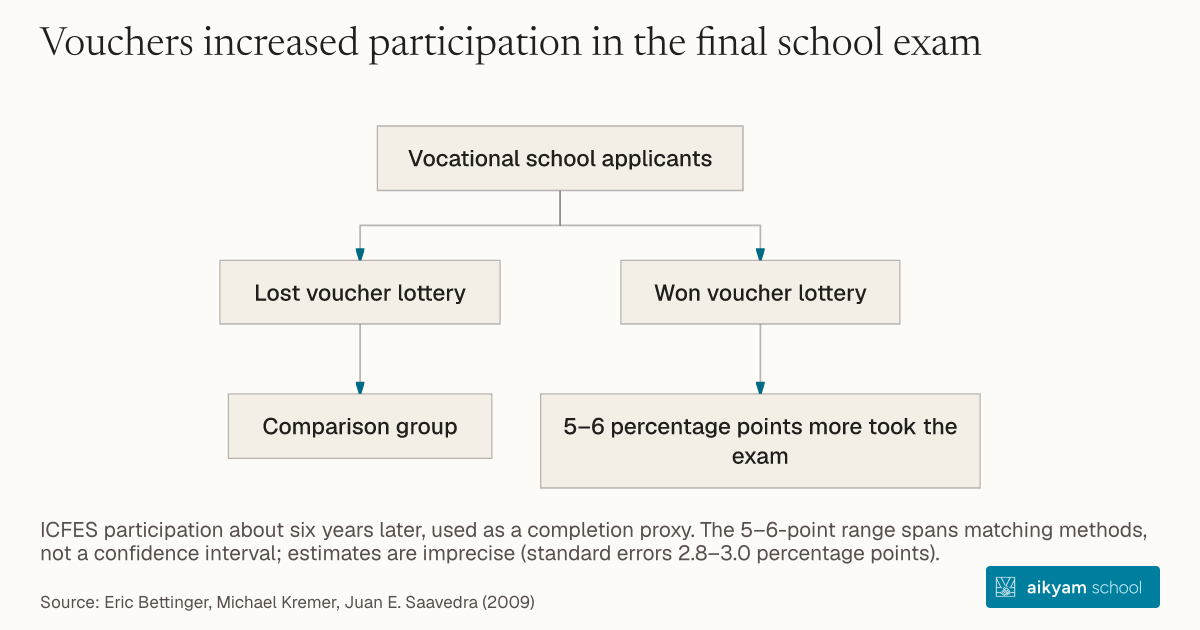
Vocational school applicants
- Lost voucher lottery
- Comparison group
- Won voucher lottery
- 5–6 percentage points more took the exam
ICFES participation about six years later, used as a completion proxy. The 5–6-point range spans matching methods, not a confidence interval; estimates are imprecise (standard errors 2.8–3.0 percentage points).
See source →Research question
Standard economic debates question whether school vouchers generate net educational productivity or merely redistribute access to high-achieving peers in a zero-sum sorting mechanism. Disentangling productive gains from peer effects requires testing voucher outcomes in settings where recipients do not gain access to observably superior peers.
Participants
N = 1,176 human student applicants (1995 cohort) and 300 target secondary schools in Bogotá, Colombia.
Study Design
Randomized controlled trial leveraging a randomized voucher lottery (PACES program) comparing lottery winners and losers among applicants to private vocational schools.
Results
Among vocational applicants, voucher winners attended schools where peers were 25% less likely to attend college and 33% more likely to drop out. Despite worse peer characteristics, voucher winners experienced a 25% increase in high school graduation likelihood and a 0.33 to 0.66 standard deviation increase in college entrance exam (ICFES) scores.
Takeaway
Evaluate school voucher productivity by isolating sub-populations where lottery mechanisms assign recipients to lower-performing peer groups to control for zero-sum peer redistribution.
Source and citation
See source →Read alongside the research
Plain-English glossary
Original explanations, informed by the references below. Examples are illustrations, not data from the studies above. The research text stays unchanged.
- Randomized controlled trial
A study that uses chance, like drawing lots, to decide who receives each option being compared. Researchers compare the groups’ outcomes to estimate the effect of those options.
ExampleA lottery assigns volunteers to a training programme or a comparison group. Researchers then compare their outcomes.
GET-IT glossary · Randomized study ↗Read more about randomized controlled trial →