In Simple Words
Operational fidelity benchmarking is like a physical therapy clinic setting explicit weekly appointments and exercise milestones for patients; without fixed schedule requirements, patients visit irregularly and fail to recover, whereas mandatory contact cadences ensure every patient receives the full therapeutic dose.
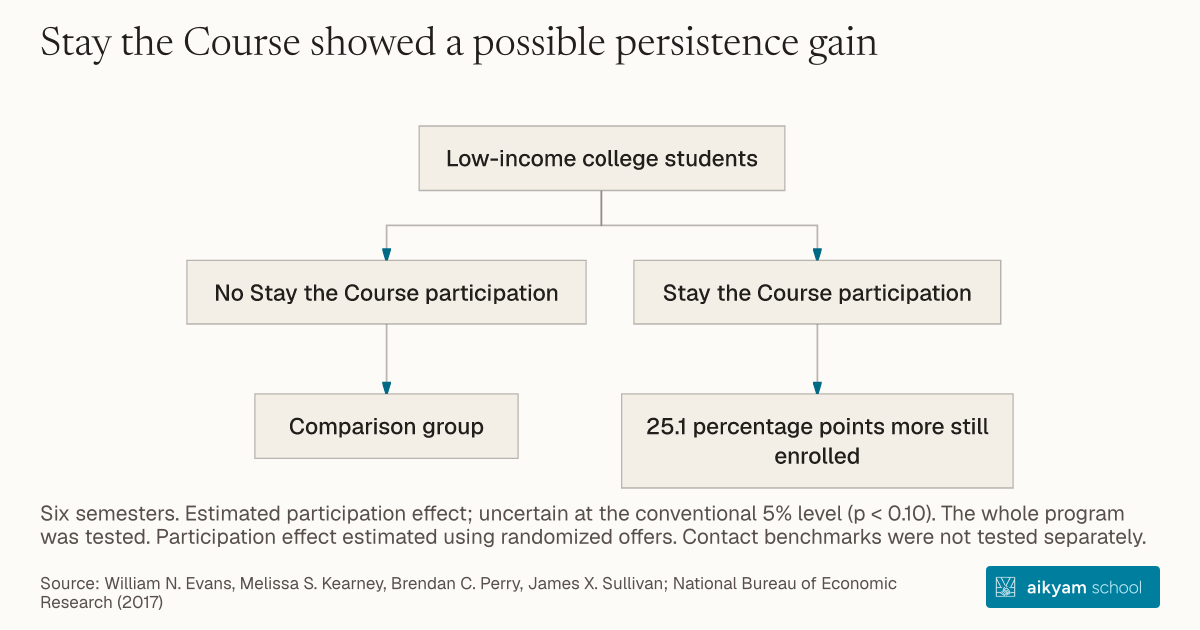
Low-income college students
- No Stay the Course participation
- Comparison group
- Stay the Course participation
- 25.1 percentage points more still enrolled
Six semesters. Estimated participation effect; uncertain at the conventional 5% level (p < 0.10). The whole program was tested. Participation effect estimated using randomized offers. Contact benchmarks were not tested separately.
See source →Research question
Mentoring interventions often suffer from wide variance in advisor-student contact frequency, leading to diluted treatment intensity and inconsistent longitudinal retention outcomes across participant cohorts.
Participants
N = 94 active treatment group participants at Tarrant County College Trinity River Campus in Fort Worth, Texas.
Study Design
Qualitative and administrative implementation study establishing explicit advisor-student contact benchmarks in Spring 2015 (weekly reciprocal contact, bi-weekly in-person meetings, 3-week goal completions).
Results
Implementation benchmarking increased student-navigator interaction frequency, directly preceding the emergence of statistically significant six-semester persistence gains (25.1 percentage points TOT, p < 0.10).
Takeaway
Establish explicit quantitative contact benchmarks—such as mandatory bi-weekly in-person meetings and weekly digital check-ins—for case managers to ensure intervention fidelity.
Source and citation
See source →Read alongside the research
Plain-English glossary
Original explanations, informed by the references below. Examples are illustrations, not data from the studies above. The research text stays unchanged.
- Longitudinal study
A study that checks the same group of people at different times. This lets researchers examine how things change over time.
ExampleResearchers ask the same workers about their wellbeing at the start, after three months and after six months.
NICE · Longitudinal study ↗Read more about longitudinal study →- Percentage points
The difference between two percentages.
ExampleA rise from 40% to 50% is 10 percentage points. Relative to the starting value, that is a 25% increase.
Office for National Statistics · Percentages ↗Read more about percentage points →- Statistically significant
A label used when a result passes a chosen statistical threshold, often p < 0.05. It does not show how large or useful an effect is. A result that is not statistically significant does not prove there is no effect.
ExampleA study reports p = 0.03 against a 0.05 threshold. It passes that test, but the effect could still be too small to matter.
American Statistical Association · Statement on p-values ↗Read more about statistically significant →