In Simple Words
Offering case management to students across different academic preparation levels is like providing advanced flight coaching to student pilots; pilots who already possess basic flight mechanics benefit immensely from navigation coaching to reach their destination, whereas pilots whose engines are broken require basic mechanical repair before flight coaching can make a difference.
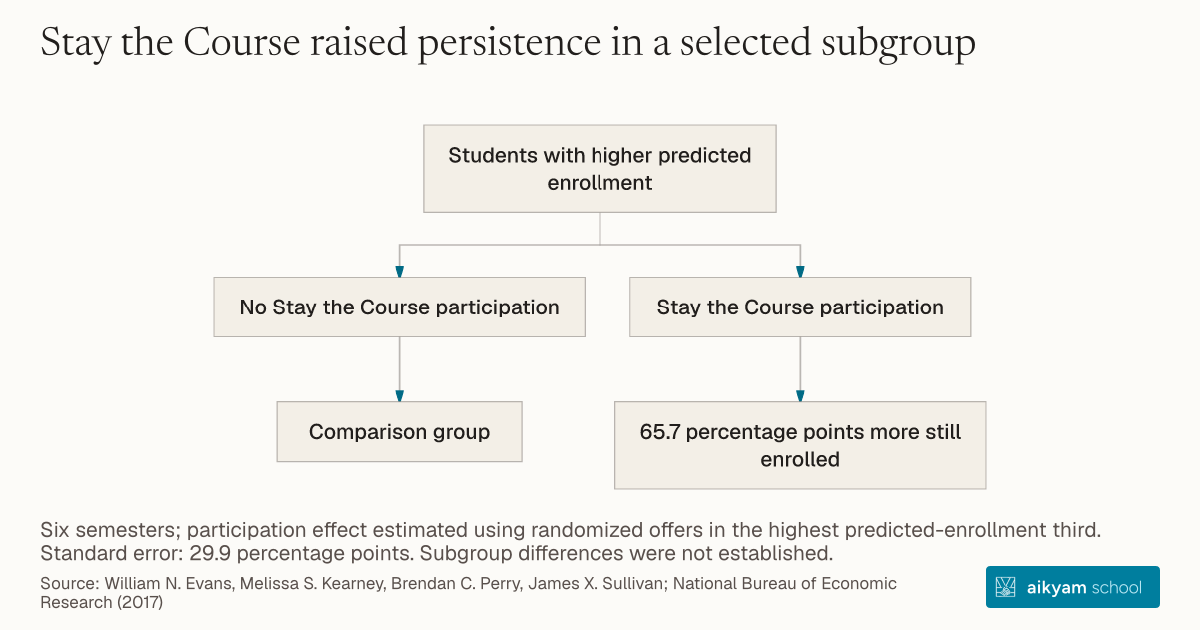
Students with higher predicted enrollment
- No Stay the Course participation
- Comparison group
- Stay the Course participation
- 65.7 percentage points more still enrolled
Six semesters; participation effect estimated using randomized offers in the highest predicted-enrollment third. Standard error: 29.9 percentage points. Subgroup differences were not established.
See source →Research question
Student retention initiatives often assume uniform effectiveness across varying levels of baseline student preparation, failing to identify which specific academic risk tiers derive the highest marginal benefit from intensive non-academic case management.
Participants
N = 869 low-income students stratified into terciles based on baseline predicted probability (prognosis score) of earning a degree.
Study Design
Repeated split sampling (RSS) methodology (Abadie et al., 2013) using logit prognosis scores across 1,000 split samples with 100 bootstrap iterations per split sample.
Results
Participants in the top third of baseline degree propensity achieved a 65.7 percentage point increase in six-semester college enrollment (TOT, p < 0.05) and a 41.9 percentage point increase in degree completion (TOT, p < 0.10), whereas lower propensity terciles exhibited no statistically significant gains.
Takeaway
Target intensive case management resources toward low-income students who maintain baseline academic eligibility but face significant non-academic life disruption risks.
Source and citation
See source →Read alongside the research
Plain-English glossary
Original explanations, informed by the references below. Examples are illustrations, not data from the studies above. The research text stays unchanged.
- Baseline
The starting measurements in a study. Researchers use these to compare what participants were like at the start with what happens later.
ExampleBefore a training programme starts, researchers measure workers’ earnings. That first measurement is the baseline.
GET-IT glossary · Baseline characteristics ↗Read more about baseline →- Percentage points
The difference between two percentages.
ExampleA rise from 40% to 50% is 10 percentage points. Relative to the starting value, that is a 25% increase.
Office for National Statistics · Percentages ↗Read more about percentage points →- Statistically significant
A label used when a result passes a chosen statistical threshold, often p < 0.05. It does not show how large or useful an effect is. A result that is not statistically significant does not prove there is no effect.
ExampleA study reports p = 0.03 against a 0.05 threshold. It passes that test, but the effect could still be too small to matter.
American Statistical Association · Statement on p-values ↗Read more about statistically significant →