In Simple Words
Imagine a local mechanic who refuses to apply for a town government vehicle maintenance contract because the mechanic believes the mayor only awards contracts to relatives. When an independent auditor presents clear evidence showing the bidding process is fair and transparent, the mechanic finally submits a bid and wins a government contract.
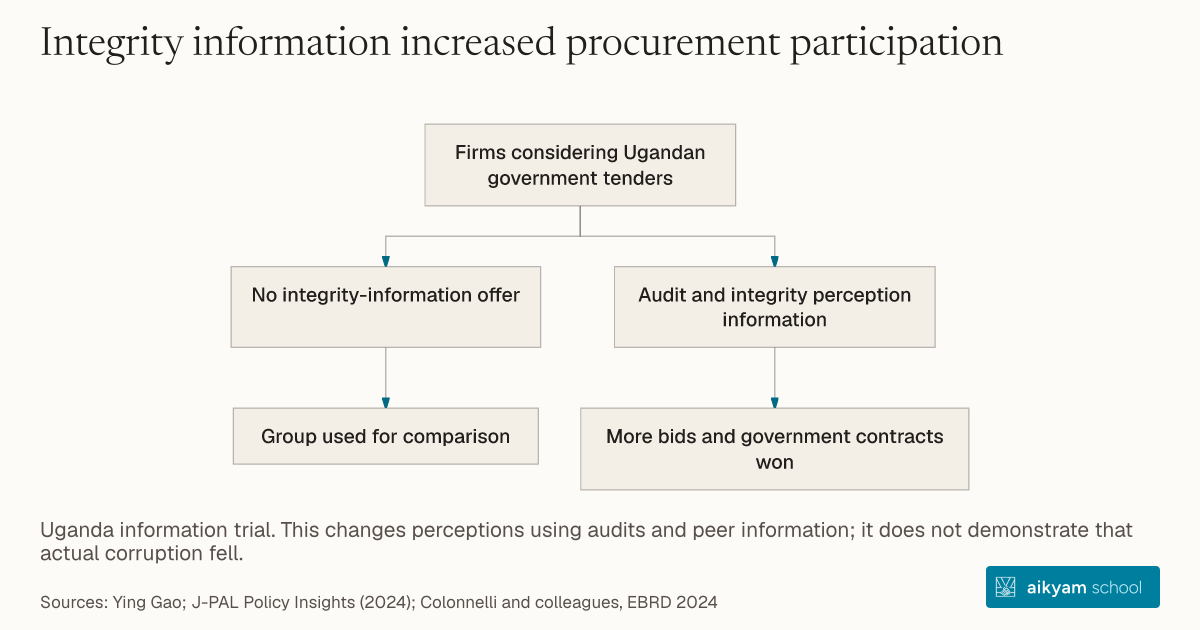
Firms considering Ugandan government tenders
- No integrity-information offer
- Group used for comparison
- Audit and integrity perception information
- More bids and government contracts won
Uganda information trial. This changes perceptions using audits and peer information; it does not demonstrate that actual corruption fell.
See source →Information conditions — EBRD working paper ↗Research question
Small and medium enterprises in low- and middle-income countries often refrain from bidding on government supply tenders due to widespread perceptions of public sector corruption and non-transparent selection processes. This informational friction reduces market competition and deprives formal firms of lucrative state contracts.
Participants
Small and medium enterprise owners in Uganda.
Study Design
Randomized controlled field experiment evaluating public procurement participation following information interventions on institutional corruption.
Results
Correcting misperceptions about public sector corruption significantly increased the frequency with which firms submitted bids for government tenders and increased the number of public contracts won by participating firms.
Takeaway
Provide small and medium business owners with transparent performance data and objective information regarding public procurement auditing to dispel false corruption perceptions and increase tender participation.