In Simple Words
Think of a store owner in a country where the police and courts take ten years to investigate shoplifting. The owner cannot hire a professional manager to buy supplies because the manager could take secret cash kickbacks from suppliers without any fear of legal punishment, forcing the owner to handle every single task personally.
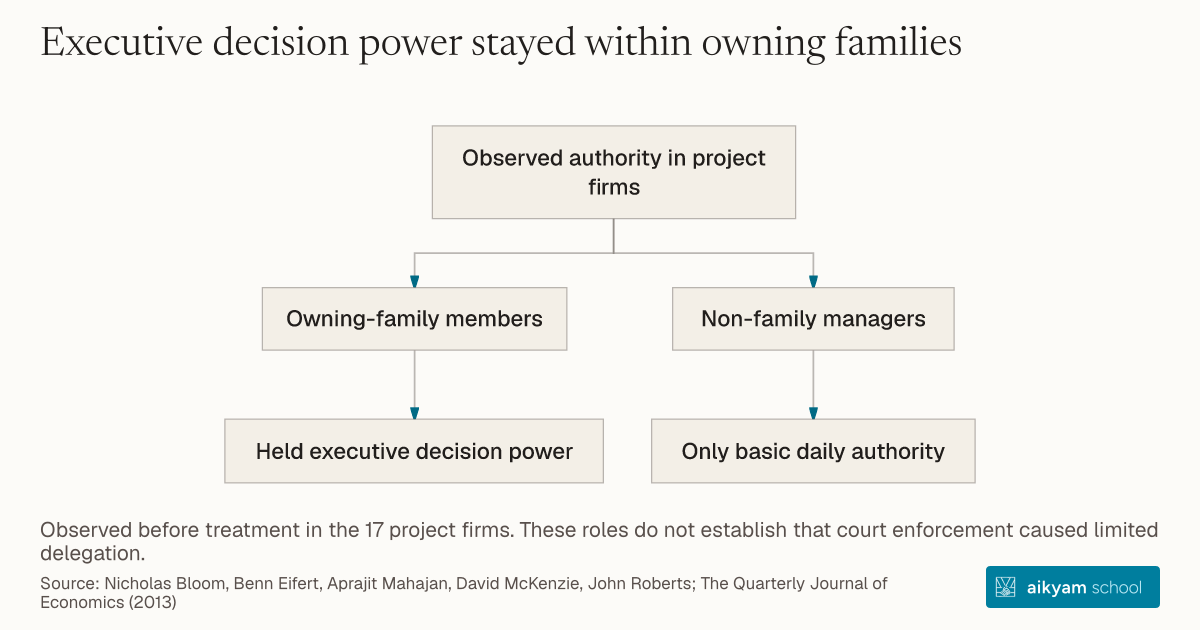
Observed authority in project firms
- Owning-family members
- Held executive decision power
- Non-family managers
- Only basic daily authority
Observed before treatment in the 17 project firms. These roles do not establish that court enforcement caused limited delegation.
See source →Research question
Weak legal enforcement and judicial inefficiency prevent firm owners from prosecuting dishonest employees, creating high agency costs that block delegation to professional non-family managers.
Participants
113 woven cotton fabric manufacturing firms near Mumbai, India.
Study Design
Cross-sectional survey evaluating decision delegation indices across plant managers related vs unrelated to firm directors.
Results
100% of surveyed firms were family-owned and managed; zero non-family managers held financial or procurement decision-making authority prior to management practice interventions.
Takeaway
Establish judicial enforcement mechanisms and contract recovery institutions to reduce agency risk and facilitate managerial delegation.