In Simple Words
Think of a worker having a toolkit with complex machinery manual tools but being too hesitant to ask the shop supervisor for instructions on how to use them. Soft skills training acts like giving the worker a loudspeaker and confidence to request technical upskilling, allowing them to operate more complex tools and unlock higher productivity.
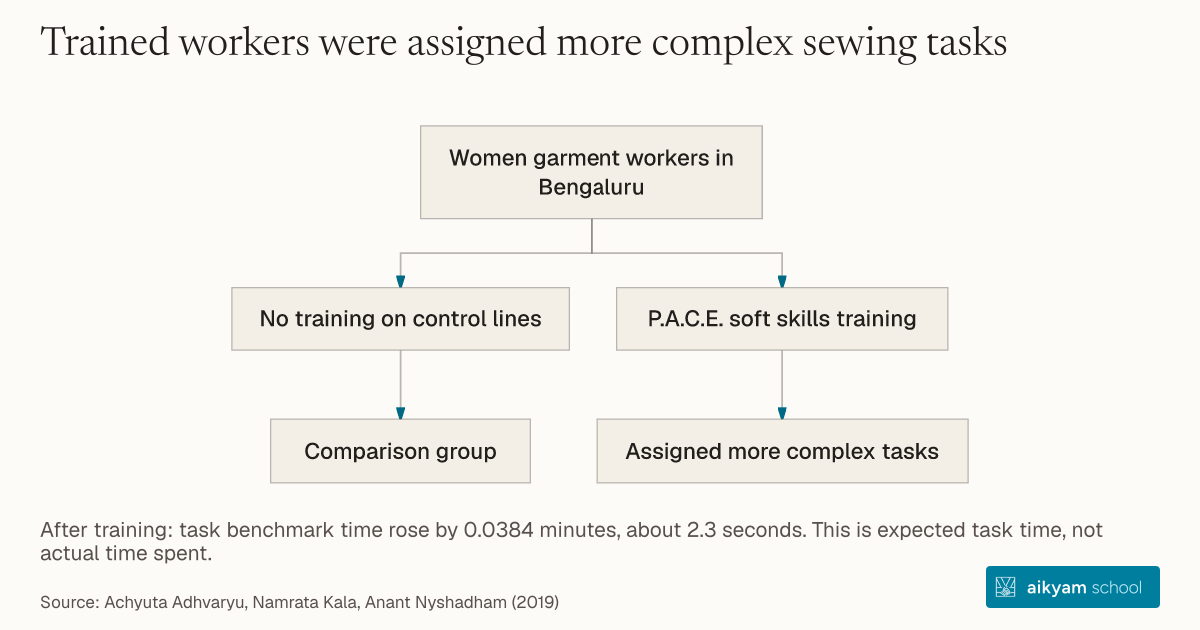
Women garment workers in Bengaluru
- No training on control lines
- Comparison group
- P.A.C.E. soft skills training
- Assigned more complex tasks
After training: task benchmark time rose by 0.0384 minutes, about 2.3 seconds. This is expected task time, not actual time spent.
See source →Research question
Firms often treat soft skills and technical skills as distinct, isolated training investments, neglecting how interpersonal confidence and communication drive frontline workers to actively seek out technical skill development.
Participants
N = 621 surveyed female garment workers (survey sub-sample of 2,703 total RCT participants) in Bengaluru, India.
Study Design
Randomized controlled trial (RCT) with survey measures of technical training requests, operation complexity (Standard Allowable Minutes), and efficiency mediation analysis.
Results
Trained workers were 15.8 percentage points more likely to request technical skill development training (p < 0.01; control mean = 24.9%), leading to assignment to more complex operations (SAM increased by 0.0384 minutes, p < 0.05), while efficiency gains were largest among machine operators with technical skills (+4.95 percentage points, p < 0.10).
Takeaway
Pair workplace soft skills training with clear request channels for technical upskilling to encourage workers to voluntarily seek technical training and manage higher-complexity operations.
Source and citation
See source →Read alongside the research
Plain-English glossary
Original explanations, informed by the references below. Examples are illustrations, not data from the studies above. The research text stays unchanged.
- Percentage points
The difference between two percentages.
ExampleA rise from 40% to 50% is 10 percentage points. Relative to the starting value, that is a 25% increase.
Office for National Statistics · Percentages ↗Read more about percentage points →- Randomized controlled trial
A study that uses chance, like drawing lots, to decide who receives each option being compared. Researchers compare the groups’ outcomes to estimate the effect of those options.
ExampleA lottery assigns volunteers to a training programme or a comparison group. Researchers then compare their outcomes.
GET-IT glossary · Randomized study ↗Read more about randomized controlled trial →