In Simple Words
Imagine a shopkeeper who wants to buy an expensive new sewing tool but spends leftover cash on daily family needs. If a trusted collector stops by the shop door every afternoon to lock away a small coin in a piggy bank, the shopkeeper builds a dedicated reserve without relying on bank branches or self-control alone.
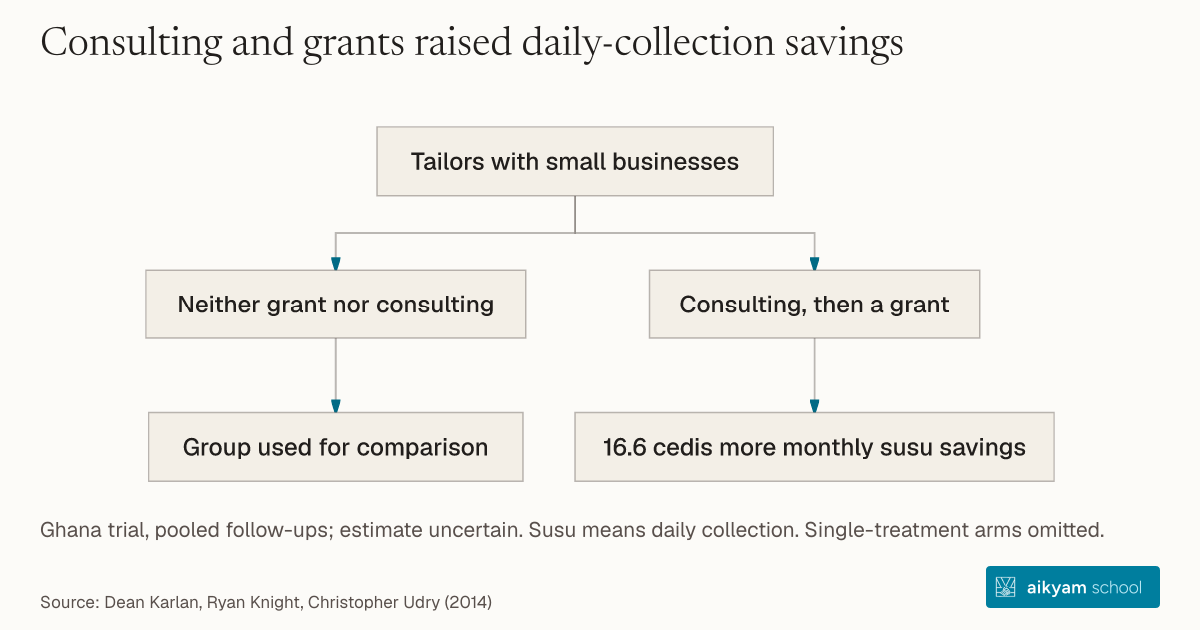
Tailors with small businesses
- Neither grant nor consulting
- Group used for comparison
- Consulting, then a grant
- 16.6 cedis more monthly susu savings
Ghana trial, pooled follow-ups; estimate uncertain. Susu means daily collection. Single-treatment arms omitted.
See source →Research question
Microentrepreneurs facing credit constraints often lack structured mechanisms to accumulate capital for business assets. When advisory support encourages goal-directed financial discipline, daily doorstep collection mechanisms (susu savings) can be activated to accumulate liquid reserves and supplement grant funding.
Participants
N = 150 urban microenterprise tailors in Accra, Ghana.
Study Design
Randomized Controlled Trial evaluating total, bank, and susu savings across 8 survey waves over 24 months.
Results
Combining capital grants and consulting nearly doubled monthly susu savings from a baseline mean of 18.6 GH¢ to 28.38 GH¢ in Round 6 (p < 0.01) and maintained a pooled average increase of 16.63 GH¢ across rounds (p < 0.10). Capital-only recipients did not increase susu savings significantly (2.16 GH¢ pooled, p > 0.10).
Takeaway
Pair liquidity grants with structured daily micro-savings collection mechanisms and advisory goal-setting to help entrepreneurs accumulate asset reserves.
Source and citation
See source →Read alongside the research
Plain-English glossary
Original explanations, informed by the references below. Examples are illustrations, not data from the studies above. The research text stays unchanged.
- Baseline
The starting measurements in a study. Researchers use these to compare what participants were like at the start with what happens later.
ExampleBefore a training programme starts, researchers measure workers’ earnings. That first measurement is the baseline.
GET-IT glossary · Baseline characteristics ↗Read more about baseline →- Randomized controlled trial
A study that uses chance, like drawing lots, to decide who receives each option being compared. Researchers compare the groups’ outcomes to estimate the effect of those options.
ExampleA lottery assigns volunteers to a training programme or a comparison group. Researchers then compare their outcomes.
GET-IT glossary · Randomized study ↗Read more about randomized controlled trial →