Try, learn and adjust
Check safe club access outside school hours
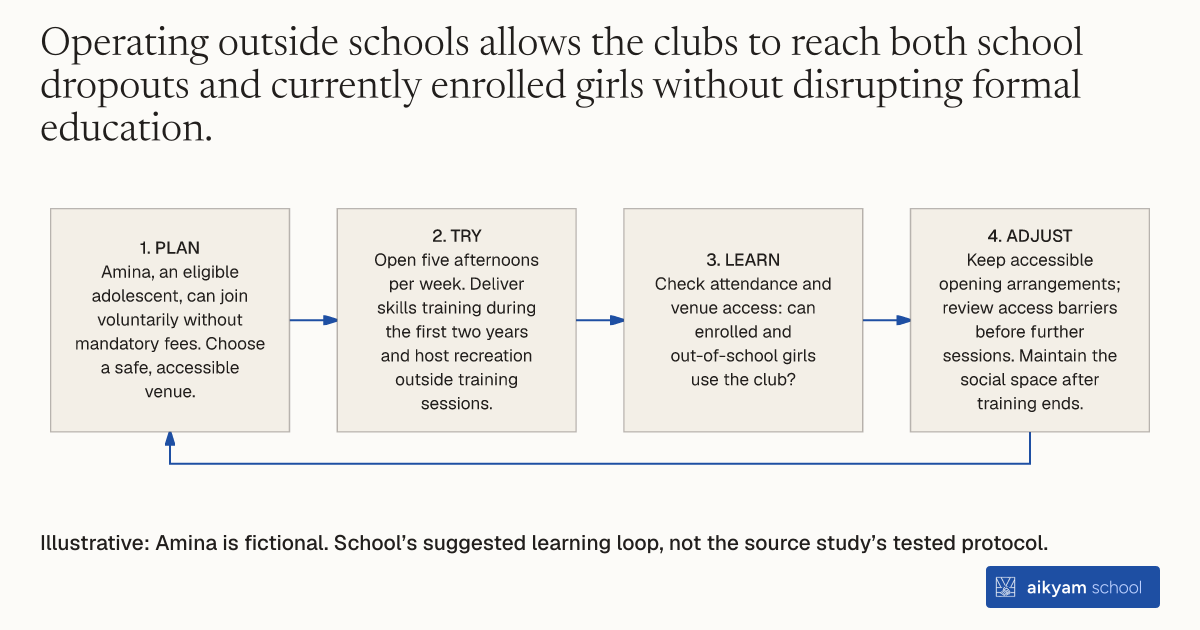
- Plan: Amina, an eligible adolescent, can join voluntarily without mandatory fees. Choose a safe, accessible venue.
- Try: Open five afternoons per week. Deliver skills training during the first two years and host recreation outside training sessions.
- Learn: Check attendance and venue access: can enrolled and out-of-school girls use the club?
- Adjust: Keep accessible opening arrangements; review access barriers before further sessions. Maintain the social space after training ends.
Illustrative: Amina is fictional. School’s suggested learning loop, not the source study’s tested protocol.
See source →School’s suggested loop, not a tested source procedure. Observe voluntary attendance and safe-space access; do not attribute programme-wide outcomes to the venue alone.
How
When to use
Adolescent girls in developing countries often face high youth unemployment, early marriage, and teen pregnancy. These challenges interact to limit investments in human capital and enforce dependence on men. Establish dedicated youth clubs outside of traditional school environments to provide girls with a protected space to gather, socialize, and build skills.
Establish community-based adolescent development clubs outside of school hours to deliver combined vocational and life skills training in a safe environment.
- Local BRAC staff select a fixed meeting location in the community that is safe and accessible to adolescent girls.
- Female community mentors open the club five afternoons per week outside of regular school hours.
- Mentors and hired professionals deliver vocational training and life skills modules during the first two years of operation.
- Mentors host recreational activities such as reading, staging dramas, singing, dancing, and playing games outside training sessions.
- Program staff allow eligible girls aged 14 to 20 to participate voluntarily without paying mandatory fees.
- Club managers maintain the venue as a continuing safe social space after formal training ends in year two.
Why it works
Delivering activities in a designated protected space led by near-peer mentors creates a comfortable environment for girls to privately discuss sensitive health, social, and economic issues.
Example
BRAC established 100 adolescent development clubs in treated communities across urban, semi-urban, and rural areas in Uganda. The clubs reached eligible girls aged 14 to 20, achieving a 21% voluntary participation rate across the communities. Participating girls attended meetings one to two times per week over two years and maintained access to the safe social space through four years.
About the study
Participants
4,888 adolescent girls tracked at midline and 3,522 at endline across 150 communities in Kampala, Mukono, Iganga, and Jinja, Uganda, with average baseline age of 16.3 years.
Study Design
Cluster randomized control trial across 150 communities (100 treatment, 50 control) stratified by 10 branch offices, evaluating outcomes at baseline, midline (2 years), and endline (4 years) using OLS ANCOVA and Lee bounds.
Results
Four years post-intervention, engagement in income-generating activities increased by 48%, self-employment rates rose by 50%, teen pregnancy fell by 34%, early marriage/cohabitation dropped by 62%, and reporting sex against will decreased by 31%.