Try, learn and adjust
Check clubs provide both life skills and trades
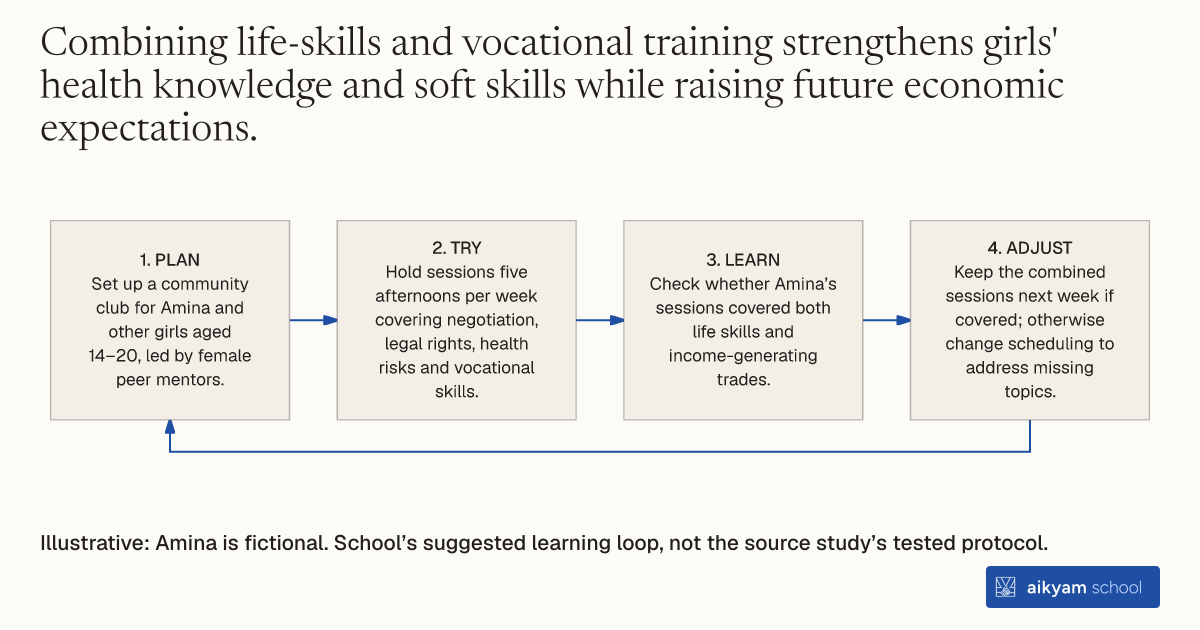
- Plan: Set up a community club for Amina and other girls aged 14–20, led by female peer mentors.
- Try: Hold sessions five afternoons per week covering negotiation, legal rights, health risks and vocational skills.
- Learn: Check whether Amina’s sessions covered both life skills and income-generating trades.
- Adjust: Keep the combined sessions next week if covered; otherwise change scheduling to address missing topics.
Illustrative: Amina is fictional. School’s suggested learning loop, not the source study’s tested protocol.
See source →School’s suggested, untested learning loop. Observe session frequency and both training areas; this check does not separate their effects or establish pregnancy reductions.
How
When to use
Adolescent girls in low-income settings face high risks of early pregnancy and limited economic control over their futures. Establishing dedicated community clubs provides girls with a safe venue to build life skills and learn income-generating trades. This approach targets adolescent females aged 14 to 20 outside formal school settings.
Establish community-based clubs led by female peer mentors to deliver life-skills and vocational training to adolescent girls.
- Community organizers set up a local club space reserved for adolescent females aged 14 to 20.
- Female peer mentors conduct sessions five afternoons per week.
- Mentors deliver life-skills instruction covering negotiation, legal rights, and health risks such as pregnancy and HIV.
- Mentors provide vocational training to support self-employment and income generation.
Why it works
Financial self-reliance improves girls' agency and bargaining power to avoid risky sexual behavior.
Example
In Uganda from 2008 to 2012, BRAC established club sessions five afternoons per week for females aged 14 to 20, which increased consistent condom use by 13 percentage points and reduced early childbearing by 2.7 percentage points after two years.