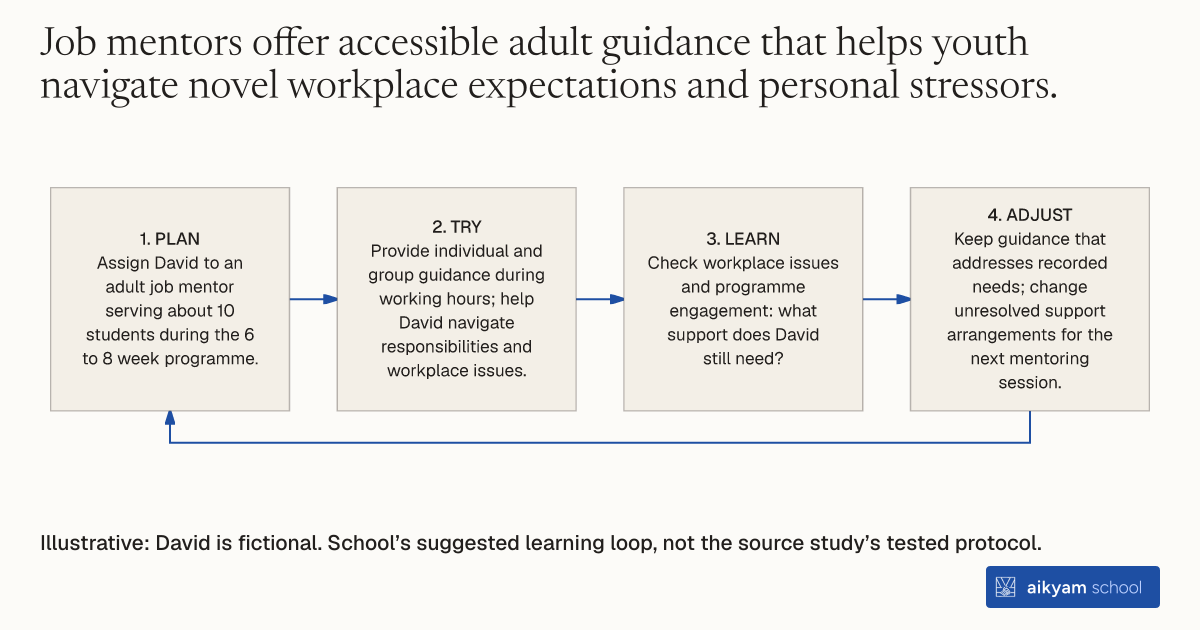
Try, learn and adjust
Check workplace mentoring support
- Plan: Assign David to an adult job mentor serving about 10 students during the 6 to 8 week programme.
- Try: Provide individual and group guidance during working hours; help David navigate responsibilities and workplace issues.
- Learn: Check workplace issues and programme engagement: what support does David still need?
- Adjust: Keep guidance that addresses recorded needs; change unresolved support arrangements for the next mentoring session.
Illustrative: David is fictional. School’s suggested learning loop, not the source study’s tested protocol.
See source →School’s suggested, untested learning loop. Observe workplace responsibilities, issues and programme engagement; mentoring alone is not the evaluated package.
How
When to use
Disadvantaged adolescents entering subsidized summer jobs often face personal and professional challenges that threaten program retention and performance. Providing adult mentorship in low student-to-mentor ratios offers structured guidance during work placements. This approach supports high-risk youth through workplace adjustments and interpersonal difficulties.
Assign adult job mentors to small cohorts of youth employees to deliver continuous employment-related guidance during summer work placements.
- Hire adult job mentors to oversee youth participants in subsidized summer employment.
- Assign each job mentor to a cohort of approximately 10 student participants.
- Schedule mentors to provide continuous workplace support throughout the 6 to 8 week program period.
- Deliver individual and group employment-related guidance during working hours.
- Assist youth participants in navigating job responsibilities and resolving workplace issues.
Why it works
This consistent adult support reinforces positive behaviors and helps participants maintain program engagement.
Example
In Chicago's One Summer Chicago Plus program, adult job mentors were assigned to serve cohorts of about 10 students each, providing employment-related guidance across the 6 to 8 week program for youth who achieved a 35 percent reduction in violent crime arrests.
About the study
Participants
5,216 male youth ages 16–22 in Chicago across 2012 and 2013 cohorts (>90% free/reduced lunch, ~20–47% prior arrest history, residing in neighborhoods with ~20% unemployment and 33% household poverty).
Study Design
Randomized Controlled Trial (RCT) assigning applicants to OSC+ treatment (with job mentors serving ~10 students each) or control groups, tracking long-term arrests using Chicago Police Department and Illinois State Police records.
Results
OSC+ participation reduced violent crime arrests by 6.4 arrests per 100 youth over one year (a 35 percent reduction from a baseline of 18.3 arrests per 100 youth), with reductions persisting after the summer program ended.