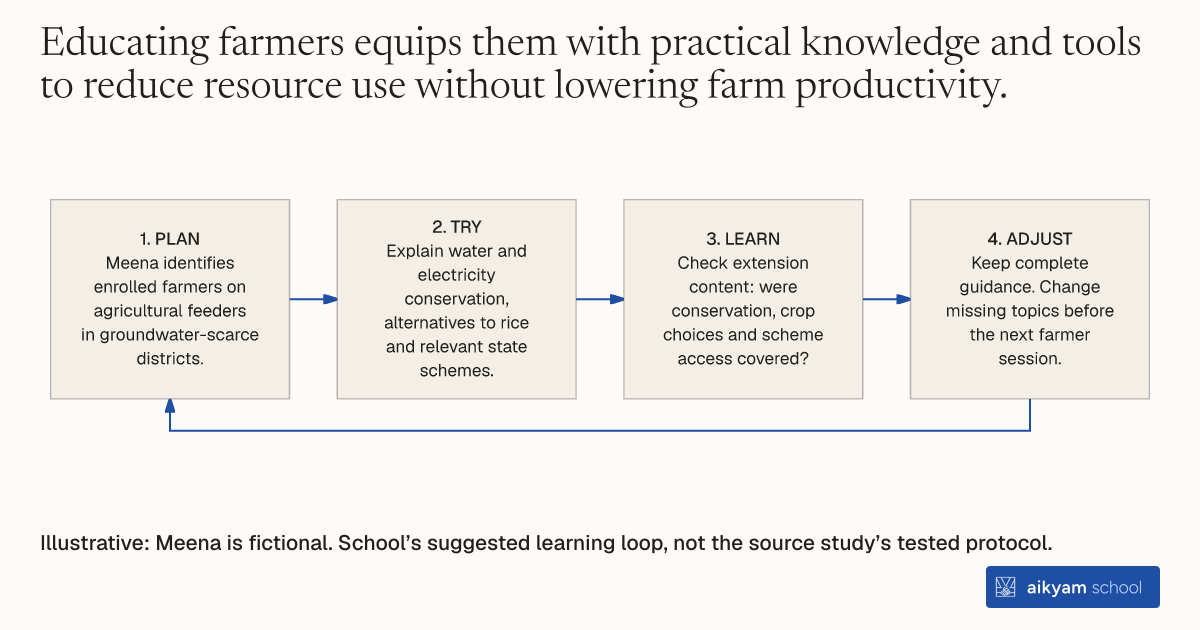
Try, learn and adjust
Check water-saving extension coverage
- Plan: Meena identifies enrolled farmers on agricultural feeders in groundwater-scarce districts.
- Try: Explain water and electricity conservation, alternatives to rice and relevant state schemes.
- Learn: Check extension content: were conservation, crop choices and scheme access covered?
- Adjust: Keep complete guidance. Change missing topics before the next farmer session.
Illustrative: Meena is fictional. School’s suggested learning loop, not the source study’s tested protocol.
See source →School’s suggested learning loop checks extension coverage, separately from the planned study support. Evaluation is ongoing; results are forthcoming.
How
When to use
Free agricultural electricity encourages farmers to grow water-intensive crops like rice, depleting groundwater tables across rural regions. Incentive programs alone may fail if farmers lack technical knowledge on how to reduce energy use or adopt alternative crops. This method provides farmers with educational guidance and support to save water and transition to sustainable farming.
Educate and support farmers through state agricultural departments to facilitate water conservation, crop diversification, and adoption of supportive government schemes.
- The Agriculture Department identifies enrolled farmers on agricultural electricity feeders in groundwater-scarce districts.
- Extension officers educate farmers on practical techniques to reduce electricity and water consumption during irrigation.
- Extension officers provide guidance and information on switching from water-intensive rice to alternative crops.
- Extension officers facilitate farmer adoption of existing state schemes that support water-saving agricultural practices.
Why it works
Connecting farmers to existing government schemes lowers the financial and technical barriers to switching crops.
Example
The Agriculture Department in Punjab, India, partnered with researchers and the state power distribution utility to educate farmers across 150 treatment feeders supplying 50 to 150 farmers each in 6 districts with severe groundwater depletion.
About the study
Participants
300 agricultural feeders supplying 50 to 150 farmers each across 6 districts in Punjab, India.
Study Design
Cluster randomized controlled trial integrating Agricultural Department extension services alongside voluntary direct benefit transfers for electricity across 150 treatment feeders.
Results
Program evaluation is ongoing with results forthcoming; baseline groundwater extraction reached 149 percent of natural recharge while state power utility debt reached about US\$ 3 billion.