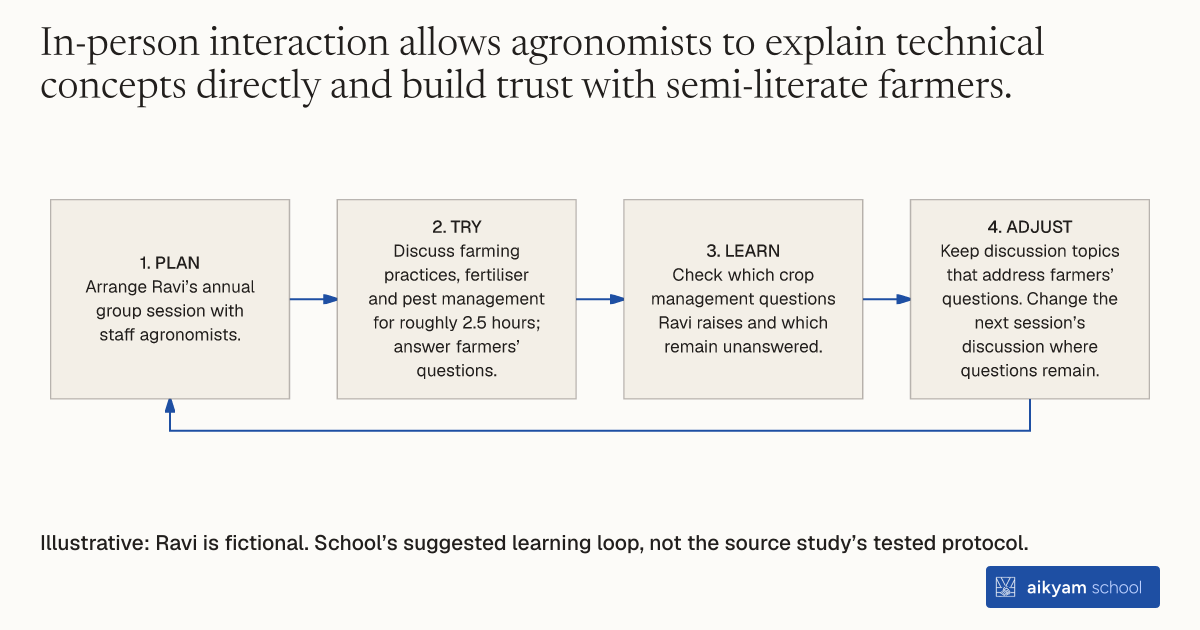
Try, learn and adjust
Check questions raised during annual farm training
- Plan: Arrange Ravi’s annual group session with staff agronomists.
- Try: Discuss farming practices, fertiliser and pest management for roughly 2.5 hours; answer farmers’ questions.
- Learn: Check which crop management questions Ravi raises and which remain unanswered.
- Adjust: Keep discussion topics that address farmers’ questions. Change the next session’s discussion where questions remain.
Illustrative: Ravi is fictional. School’s suggested learning loop, not the source study’s tested protocol.
See source →School’s suggested learning loop, not the source’s tested procedure. Observe farmers’ questions and the advice discussed. The annual session showed no incremental benefit over mobile advice alone.
How
When to use
Traditional in-person extension relies on agronomists visiting farming communities to demonstrate agricultural best practices. Farmers may distrust purely digital extension tools unless accompanied by face-to-face interaction with human experts. This method delivers face-to-face agronomic training directly to smallholders to support technology adoption and build trust.
Conduct an annual in-person training session with staff agronomists to present recommended farming practices to smallholders.
- The managing organization partners with local agronomists who possess expertise in regional crops.
- Agronomists schedule a group training session once per year in participating rural villages.
- Agronomists meet with farmers in person for roughly 2.5 hours per session.
- Agronomists present and discuss recommended agricultural practices, fertilizer usage, and pest management techniques.
- Agronomists answer direct questions from participating farmers to address specific agricultural concerns.
Why it works
Direct discussions help address specific doubts about new agricultural technologies and crop management strategies.
Example
In Gujarat, India, researchers assigned 400 cotton farmers across 40 villages to receive a single 2.5-hour annual in-person extension session alongside mobile advice. Results for this group were nearly identical to farmers receiving mobile advice alone, showing no incremental benefit from the annual in-person session.
About the study
Participants
1,200 cotton farmers across 40 villages in Ahmedabad, Gujarat, India; farmers averaged 46 years of age, four years of education, and six acres of land.
Study Design
Randomized Controlled Trial comparing mobile extension alone against mobile extension combined with an annual 2.5-hour in-person session with NGO staff agronomists.
Results
Outcomes across information gathering, seed adoption, and crop yields were nearly identical between the digital-only group and the digital plus in-person group.