Research steps
Build rainfall insurance payout rules
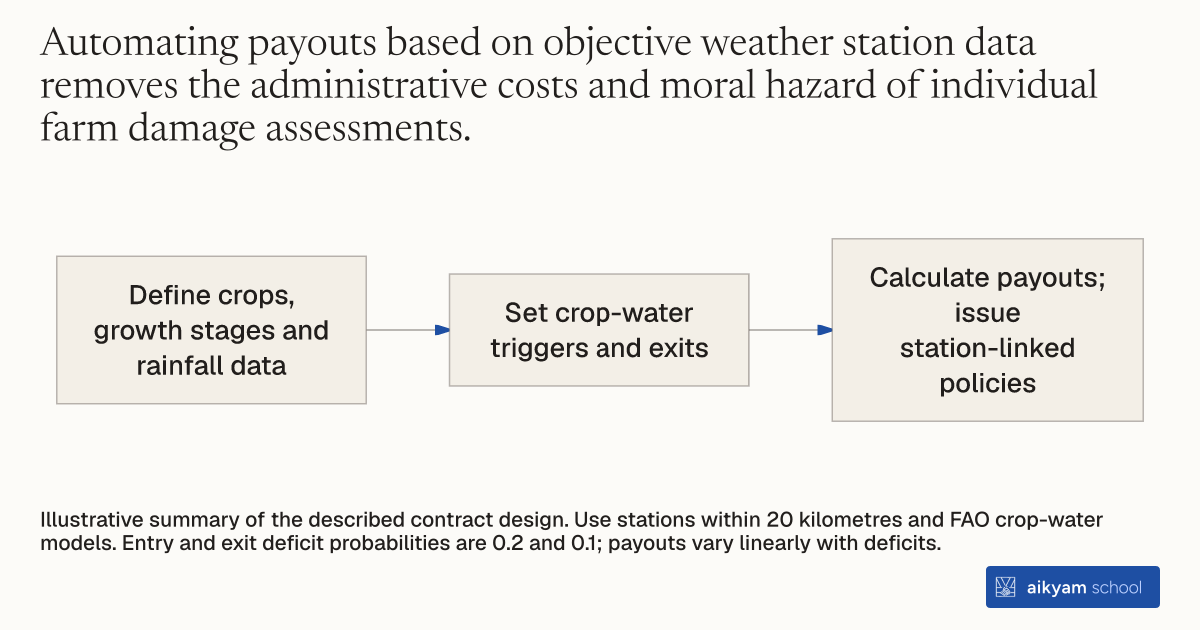
- Define crops, growth stages and rainfall data
- Set crop-water triggers and exits
- Calculate payouts; issue station-linked policies
Illustrative summary of the described contract design. Use stations within 20 kilometres and FAO crop-water models. Entry and exit deficit probabilities are 0.2 and 0.1; payouts vary linearly with deficits.
See source →How
When to use
Smallholder farmers depend on rain-fed agriculture and face severe production risk from seasonal drought shocks. Traditional crop loss verification is costly and prone to moral hazard, leaving smallholders exposed to weather volatility. The agrometeorological crop water requirement model designs trigger-and-exit index contracts that automate rainfall deficit payouts based on agronomic thresholds.
Design an agrometeorological rainfall index insurance contract using crop water requirement modeling to insure the value of agricultural inputs.
- Select target regional food and cash crops and define their growing cycle segments across early, growth, and maturation periods.
- Obtain historical daily rainfall records from local meteorological stations located within 20 kilometers of target agricultural villages.
- Apply FAO crop water requirement models to determine maximum rainfall triggers for initial damage and minimum exit thresholds for full crop failure per growth period.
- Set contract entry and exit cumulative deficit probabilities to 0.2 for partial payouts and 0.1 for full crop failure payouts.
- Calculate period-specific payouts as a linear function of observed rainfall deficits below the trigger threshold.
- Issue index policies tied to nearby weather stations to cover smallholder input purchase costs.
Why it works
Aligning trigger thresholds with FAO crop water requirement parameters ensures payouts correlate with physiological crop stress during key growth stages.
Example
Nyala Insurance and FAO agronomists designed rainfall index contracts for teff, wheat, sorghum, and maize across 49 villages in Amhara, Ethiopia; in the 2012 drought, payouts triggered in 42% of study villages, averaging \$27 per covered household.
About the study
Participants
49 villages across 4 zones (North Shewa, West Gojam, South Wello, North Wello) in Amhara Region, Ethiopia, tracked across 9 re-insurable weather stations.
Study Design
Agrometeorological model parameterization and historical weather station evaluation comparing index triggers against survey-measured normalized crop yield shocks.
Results
In the 2012 sales year, index payouts triggered in 42% of study villages with payouts ranging from 3% to 75% of the sum insured, while false-positive payouts occurred in 21% of non-shock village-years and correctly triggered in 53% of actual yield-shock village-years.