Try, learn and adjust
Check rainfall triggers and insurance payouts
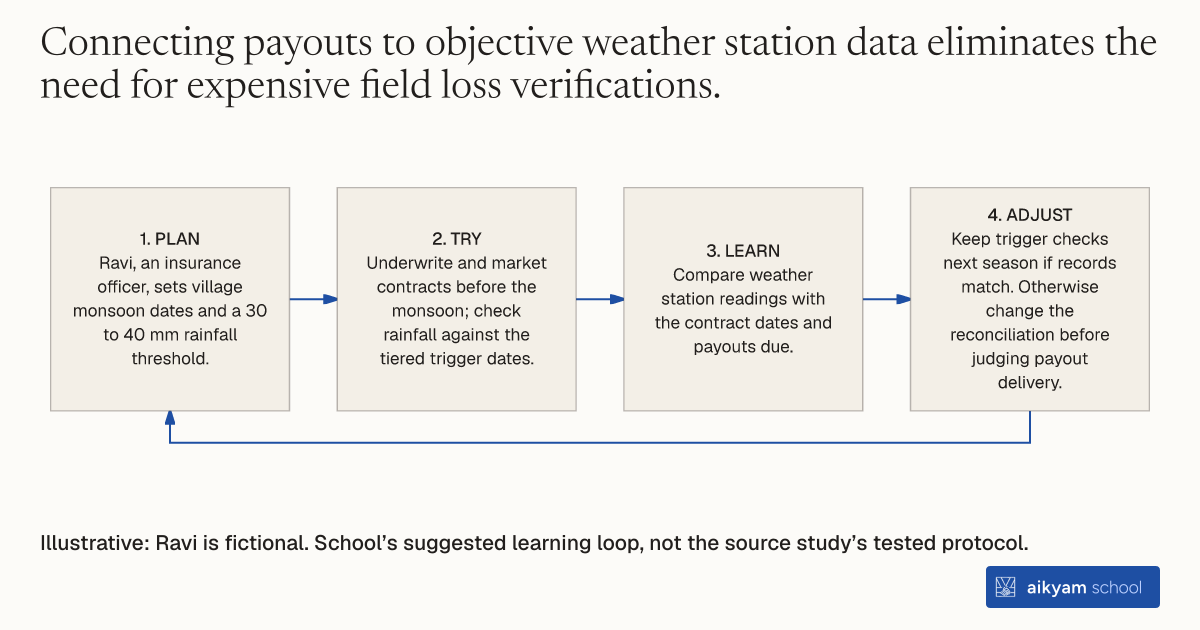
- Plan: Ravi, an insurance officer, sets village monsoon dates and a 30 to 40 mm rainfall threshold.
- Try: Underwrite and market contracts before the monsoon; check rainfall against the tiered trigger dates.
- Learn: Compare weather station readings with the contract dates and payouts due.
- Adjust: Keep trigger checks next season if records match. Otherwise change the reconciliation before judging payout delivery.
Illustrative: Ravi is fictional. School’s suggested learning loop, not the source study’s tested protocol.
See source →School’s suggested, untested learning loop. Observe rainfall, trigger dates and payouts. The example uses delays of 15, 20 and 25 days with 300, 750 and 1,200 rupees per unit.
How
When to use
Smallholder farmers and wage laborers face severe income risks from unpredictable monsoon arrival times. Traditional crop insurance requires costly individual farm damage inspections that delay relief payouts. Index insurance ties payouts to clear weather station measurements, giving rural households simple and predictable risk protection.
Design an index insurance contract that triggers automatic payouts when seasonal rainfall misses specific dates and accumulation targets.
- Determine historical average monsoon arrival dates for each target village using local rainfall records.
- Define monsoon onset as reaching a cumulative threshold of 30 to 40 mm of rainfall.
- Select three tiered calendar trigger dates corresponding to delayed monsoon arrivals, such as 15, 20, and 25 days late.
- Assign increasing cash payout values to each successive trigger date, such as 300, 750, and 1,200 rupees per contract unit.
- Underwrite and market the index contracts through an insurance partner before the monsoon season begins.
- Monitor daily precipitation at local weather stations and automatically disburse cash payouts if rainfall falls short on the trigger dates.
Why it works
Farmers and laborers receive prompt cash payouts during severe droughts, protecting household consumption and liquidity.
Example
In Andhra Pradesh, India, four sample villages experienced delayed monsoons during the Kharif season. The insurance provider automatically disbursed tiered payouts of 300, 750, or 1,200 rupees per unit to policyholders based on how many days the rainfall accumulation missed target dates.
About the study
Participants
4,667 households across 42 rural villages in Andhra Pradesh, Uttar Pradesh, and Tamil Nadu, India.
Study Design
Clustered RCT offering index contracts underwritten by the Agricultural Insurance Company of India with randomized price discounts of 0%, 10%, 50%, or 75%.
Results
Insurance take-up reached 42% across targeted households, and insured landless laborers receiving payouts reduced labor market participation by 28.5 percentage points at median rainfall deficiency.