Research survey
Check beliefs about the experiment
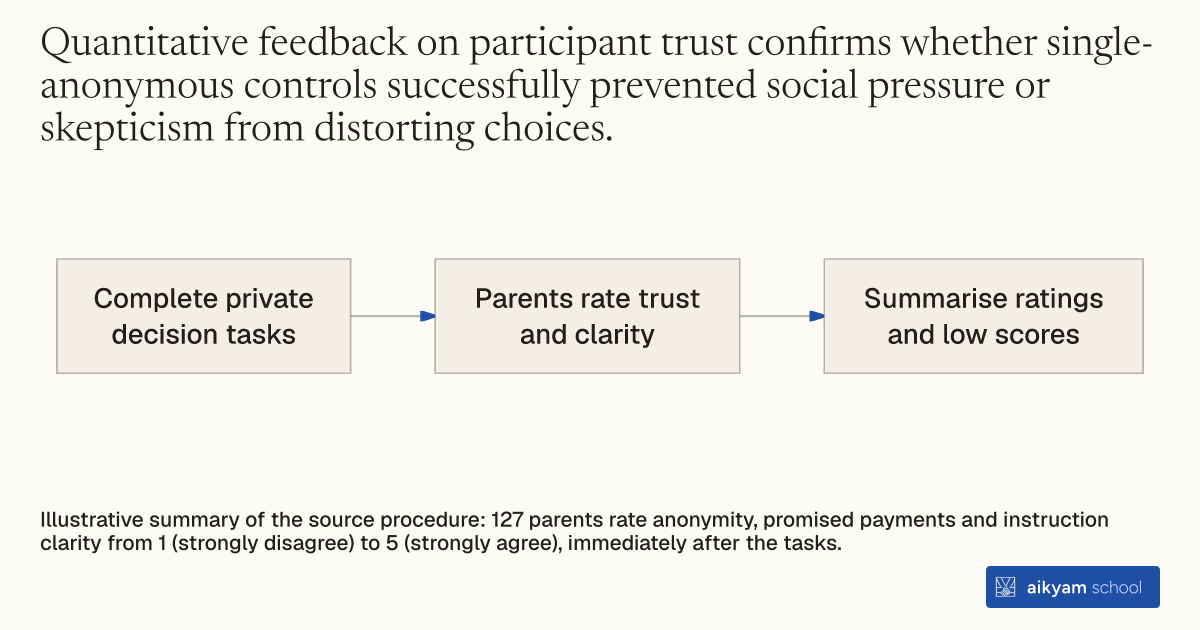
- Complete private decision tasks
- Parents rate trust and clarity
- Summarise ratings and low scores
Illustrative summary of the source procedure: 127 parents rate anonymity, promised payments and instruction clarity from 1 (strongly disagree) to 5 (strongly agree), immediately after the tasks.
See source →How
When to use
Evaluators conduct economic decision-making experiments where subjects must believe their choices are private and financially binding. Doubt about experimenter anonymity or payment fulfillment can cause social desirability bias or strategic play. This method uses structured post-experimental manipulation checks with parents to verify subject trust, procedural clarity, and perceived anonymity.
Verify experimental subject trust and comprehension by administering a structured post-experiment manipulation check survey to parents.
- Administer economic dictator games to parents in private testing rooms using single-anonymous identification tags.
- Provide a post-task survey immediately following the decision-making exercises in the parent room.
- Prompt parents to rate three procedural statements on a Likert scale from 1 (strongly disagree) to 5 (strongly agree).
- Evaluate ratings on whether procedures preserved participant anonymity, whether instructions were clear and easy to follow, and whether participants had confidence money would be paid as promised.
- Tabulate mean scores and calculate the percentage of respondents rating each statement below 3 to assess experimental validity.
Why it works
High scores verify that subjects treated experimental payouts as genuine and believed their identities were protected.
Example
In 2001, researchers in Toledo, Ohio, surveyed 127 parents following experimental dictator games. Parents reported average scores of 4.63 for preserved anonymity, 4.63 for payout confidence, and 4.78 for clear instructions on a 5-point scale, with over 90 percent rating statements 4 or 5.
About the study
Participants
127 parents of low-income applicant children participating in evaluation events in Toledo, Ohio, where 39 percent were single parents and 57 percent were African-American.
Study Design
Post-experiment manipulation check survey using a 1-to-5 Likert scale administered immediately after dictator game choices to assess single-anonymous experimental validity.
Results
Parents rated anonymity preservation at 4.63 out of 5, payout confidence at 4.63, and instruction clarity at 4.78, with only 3 parents (2.4 percent) rating any item below 3.