Research payments
Pay randomly selected decisions
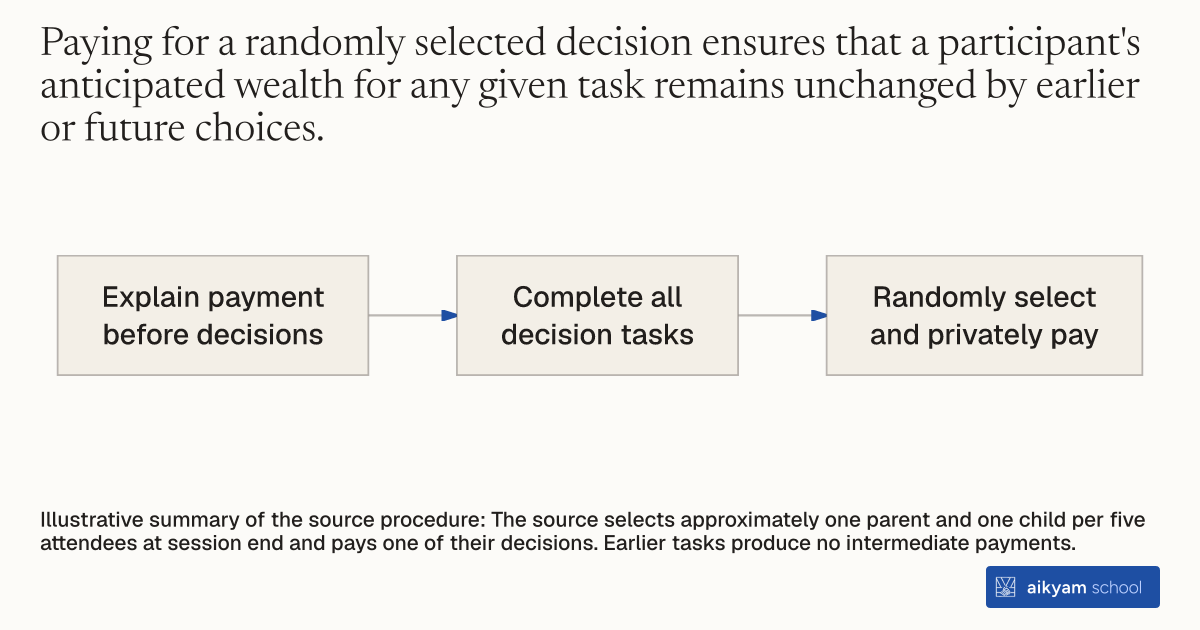
- Explain payment before decisions
- Complete all decision tasks
- Randomly select and privately pay
Illustrative summary of the source procedure: The source selects approximately one parent and one child per five attendees at session end and pays one of their decisions. Earlier tasks produce no intermediate payments.
See source →How
When to use
Evaluators conduct multiple consecutive decision-making tasks with financial stakes for subjects in experimental research. Paying subjects for every completed decision can cause accumulated earnings from early choices to alter their baseline wealth and distort choices in later tasks. This method uses a random selection payment mechanism to keep subjects' anticipated wealth constant across all experimental decisions.
Prevent wealth accumulation from distorting experimental choices across consecutive tasks by compensating participants for a randomly selected subset of decisions.
- Inform participants before decision-making begins that choices have real financial consequences but only a randomly selected decision will receive payment.
- Direct subjects to execute multiple sequential experimental tasks independently.
- Set a selection frequency, such as choosing approximately one in five participants per decision task in group sessions.
- Draw winning participants and decision tasks randomly and anonymously after all choices are submitted.
- Distribute cash or gift certificate payouts privately based strictly on the outcomes of the selected decision tasks.
Why it works
This places each decision at the same point on the subject's utility curve, preventing portfolio balancing from biasing behavioral responses.
Example
In 2001, researchers in Toledo, Ohio, conducted six dictator decisions with 191 children and 127 parents. Experimenters randomly selected one parent and one child per five attendees to receive payment for one decision, controlling wealth effects across tasks.
About the study
Participants
191 children and 127 parents from low-income applicant families attending evaluation events in Toledo, Ohio.
Study Design
Random selection payment mechanism integrated into a single-blind, single-anonymous laboratory field experiment across six sequential dictator decisions.
Results
Maintained unbiased incentive structures across all six dictator decisions, enabling detection of a \$0.75 higher donation to charities among voucher winners without distortion from intermediate earnings.