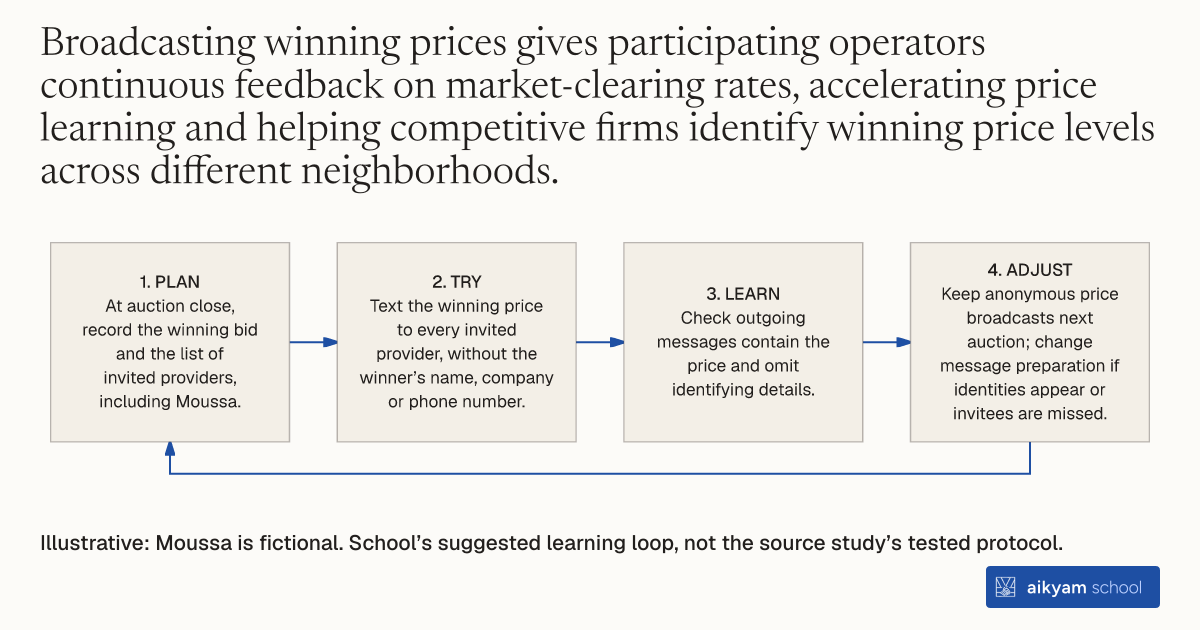
Try, learn and adjust
Check winning-price texts preserve anonymity
- Plan: At auction close, record the winning bid and the list of invited providers, including Moussa.
- Try: Text the winning price to every invited provider, without the winner’s name, company or phone number.
- Learn: Check outgoing messages contain the price and omit identifying details.
- Adjust: Keep anonymous price broadcasts next auction; change message preparation if identities appear or invitees are missed.
Illustrative: Moussa is fictional. School’s suggested learning loop, not the source study’s tested protocol.
See source →School’s suggested learning loop; not a tested source procedure. Observe message content and invited-recipient coverage. This check does not establish competitive pricing or learning.
How
When to use
Public procurement platforms need to provide price feedback to participating service providers after each auction concludes. The method addresses price opacity and slow market learning in decentralized procurement by automatically transmitting the winning contract price to all invited bidders while withholding the winner's identity. It is designed for platform designers balancing transparency, provider learning, and bid monitoring in urban utility markets.
Broadcast the final winning price via text message to all invited service providers immediately after an auction concludes.
- Call center software logs all submitted bids and identifies the winning bid amount at auction close.
- The platform generates an automated SMS broadcast message containing the numerical winning bid amount.
- The platform suppresses the winning bidder's individual name, company, and phone number to preserve winner anonymity.
- Dispatchers transmit the text message notification to every service provider invited to that specific auction round.
- Platform analysts log provider bidding responses in subsequent auctions to track price learning and convergence across neighborhoods.
Example
Following each of the 5,331 desludging procurement auctions in Dakar, Senegal, the call center sent an automated SMS text message showing the winning price to all 5 to 21 invited vacuum truck operators, allowing 126 registered truckers to learn competitive market rates while maintaining bidder anonymity.
About the study
Participants
126 registered vacuum truck operators invited across 5,331 procurement auctions in Dakar, Senegal (with 3,627 valid auctions in the analytical sample).
Study Design
Automated information feedback mechanism incorporated into randomized reverse auctions, broadcasting winning bid amounts via SMS to all invited bidders upon auction completion.
Results
Post-auction price broadcasts provided continuous market feedback across 453.0 average invitations per bidder, facilitating provider learning where winning bid arrival times in revisable auctions converged to a modal late-bidding strategy starting around the 200th auction.