Try, learn and adjust
Check predictive flood alerts reach phones
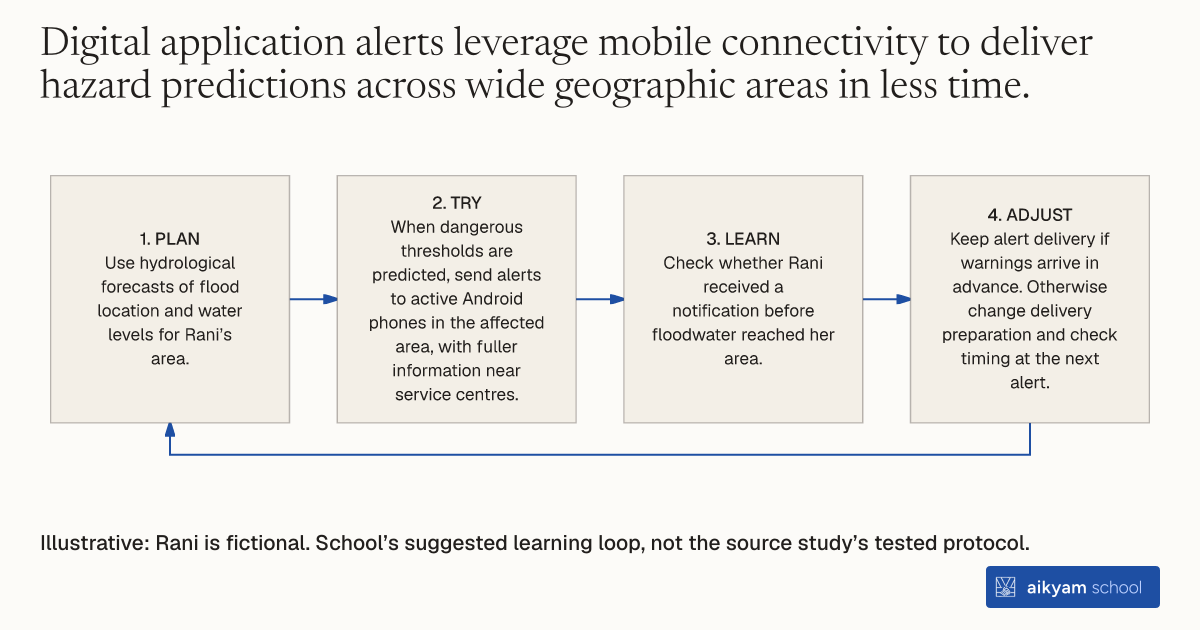
- Plan: Use hydrological forecasts of flood location and water levels for Rani’s area.
- Try: When dangerous thresholds are predicted, send alerts to active Android phones in the affected area, with fuller information near service centres.
- Learn: Check whether Rani received a notification before floodwater reached her area.
- Adjust: Keep alert delivery if warnings arrive in advance. Otherwise change delivery preparation and check timing at the next alert.
Illustrative: Rani is fictional. School’s suggested learning loop, not the source study’s tested protocol.
See source →Observe alert receipt and timing before water arrives. A receipt check does not establish reduced flood harm. School’s suggested learning loop; not a tested source procedure.
How
When to use
Floods threaten millions of rural residents in river basins, but traditional warning channels fail to reach remote communities in time. Automated digital early warning systems address this communication gap by delivering rapid hazard alerts directly to mobile devices. This method suits emergency management agencies serving vulnerable low-income populations living in flood-prone zones.
Deploy an automated smartphone early warning system to broadcast predictive flood alerts to mobile device users in threatened geographic zones.
- Technologists run hydrological forecasting models to predict the location and water level of impending floods along river basins.
- The forecasting system generates digital alerts whenever water levels are projected to reach dangerous flood thresholds.
- Google Early Warning System broadcasts automated hazard alerts to all active Android smartphones within the predicted flood area.
- The system delivers more detailed informational alerts to mobile devices located near community service centers like schools and hospitals.
- Local residents receive the smartphone notifications to gain advance warning before floodwaters reach their area.
Why it works
Early digital notifications provide vulnerable citizens with lead time to prepare or evacuate before flooding begins.
Example
Google partnered with researchers and local organizations in Bihar, India to deliver automated Android flood warnings across 319 rural panchayats.
About the study
Participants
319 panchayats across 12 flood-prone districts in Bihar, India; 634 households surveyed across 119 panchayats during the 2022 monsoon season.
Study Design
Randomized Controlled Trial evaluating digital smartphone flood alerts comparing EWS alerts alone against EWS alerts combined with trained community volunteers.
Results
Households in treatment communities received 2.37 more alerts (a 290 percent increase) on average during the 2022 flood season, were 27 percent more likely to receive any alerts, 46.5 percent more likely to receive alerts before water reached their area, and 57 percent more likely to report receiving highly accurate flood alerts.