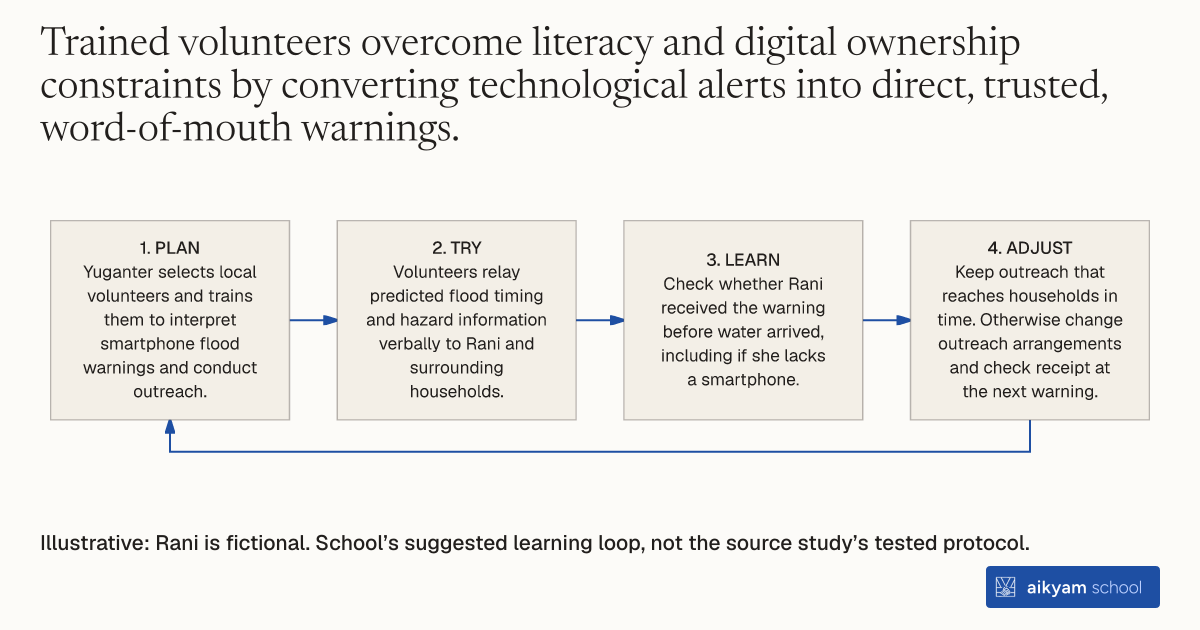
Try, learn and adjust
Check flood warnings reach households without smartphones
- Plan: Yuganter selects local volunteers and trains them to interpret smartphone flood warnings and conduct outreach.
- Try: Volunteers relay predicted flood timing and hazard information verbally to Rani and surrounding households.
- Learn: Check whether Rani received the warning before water arrived, including if she lacks a smartphone.
- Adjust: Keep outreach that reaches households in time. Otherwise change outreach arrangements and check receipt at the next warning.
Illustrative: Rani is fictional. School’s suggested learning loop, not the source study’s tested protocol.
See source →Observe warning receipt and timing. The source compares smartphone alerts with volunteers against smartphone alerts alone. School’s suggested learning loop; not a tested source procedure.
How
When to use
Low smartphone penetration and low literacy rates prevent direct digital alerts from reaching vulnerable households in remote rural areas. Deploying trained community volunteers bridges the last-mile communication barrier by translating digital notifications into direct physical outreach. This method serves disaster relief organizations and local governments managing flood risks in resource-constrained communities.
Train local community volunteers to receive digital flood warnings and actively disseminate hazard information and preparedness guidance directly to rural residents during flood events.
- Local disaster relief NGO Yuganter selects community volunteers within targeted rural panchayats.
- NGO staff train community volunteers to interpret smartphone-based early flood warnings and execute effective outreach activities.
- Google Early Warning System sends predictive digital alerts to Android smartphones held by trained volunteers when flood risks arise.
- Trained community volunteers receive smartphone alerts and verbally relay hazard information and flood timing to surrounding households across villages.
- Community volunteers conduct active outreach activities throughout the flood season to ensure off-grid and non-smartphone households receive actionable warnings before water arrives.
Why it works
Verbal community outreach ensures warnings reach vulnerable households that lack smartphones or cannot read SMS messages.
Example
Local disaster relief NGO Yuganter trained community volunteers to disseminate smartphone flood alerts across rural panchayats in Bihar, India during the 2022 monsoon season.
About the study
Participants
319 panchayats across 12 flood-prone districts in Bihar, India; 634 households surveyed across 119 panchayats during the 2022 monsoon season (June–October).
Study Design
Randomized Controlled Trial comparing smartphone early warning alerts combined with Yuganter-trained community volunteers against smartphone alerts alone without volunteers.
Results
Compared to control communities, households in communities with trained volunteers received 2.37 more alerts (a 290 percent increase) on average during the 2022 flood season, were 27 percent more likely to receive any alerts, 46.5 percent more likely to receive alerts before water reached their area, and 57 percent more likely to report receiving highly accurate flood alerts.