Try, learn and adjust
Check harvest prepayment leads to fertilizer delivery
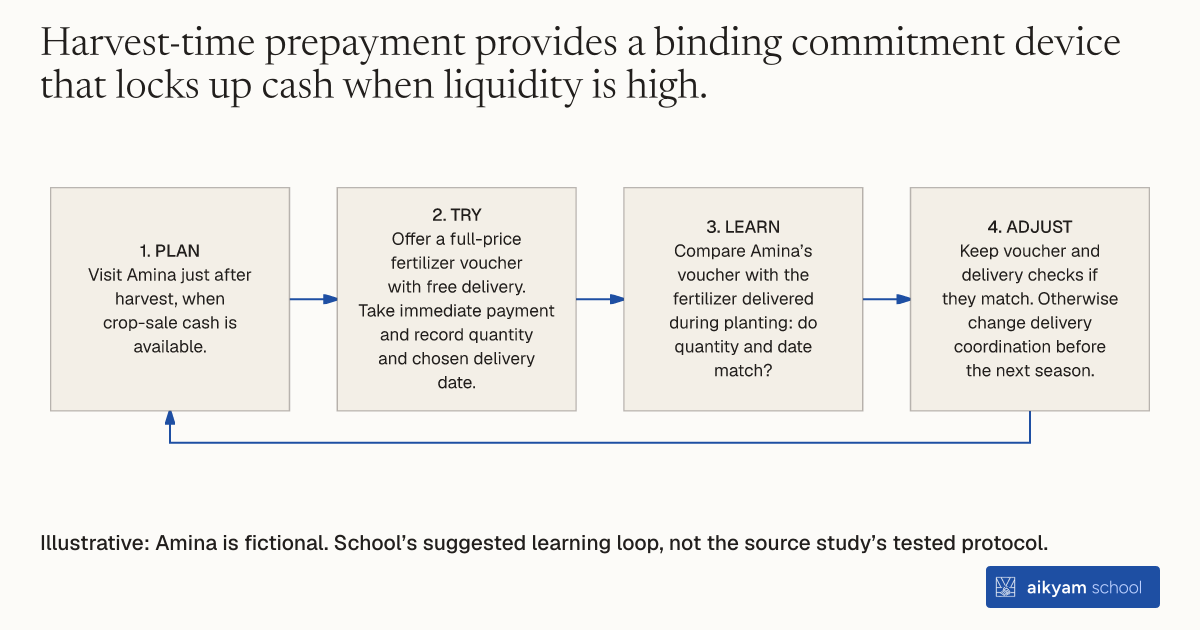
- Plan: Visit Amina just after harvest, when crop-sale cash is available.
- Try: Offer a full-price fertilizer voucher with free delivery. Take immediate payment and record quantity and chosen delivery date.
- Learn: Compare Amina’s voucher with the fertilizer delivered during planting: do quantity and date match?
- Adjust: Keep voucher and delivery checks if they match. Otherwise change delivery coordination before the next season.
Illustrative: Amina is fictional. School’s suggested learning loop, not the source study’s tested protocol.
See source →School’s suggested learning loop: observe voucher purchase, quantity and delivery timing; do not infer increased fertilizer use from purchase alone.
How
When to use
Farmers have available cash immediately after crop harvest, but they delay input purchases and spend liquidity on daily expenses. Months later at planting time, they lack the money to buy profitable inorganic fertilizer. This method helps subsistence farmers commit early harvest income toward planned agricultural inputs.
Offer farmers the opportunity to prepay for fertilizer vouchers with free delivery immediately after crop harvest.
- Send a field officer to visit subsistence farmers at home right after harvest while crop sale cash is available.
- Offer farmers the chance to purchase a fertilizer voucher at full market price with free delivery on a chosen future date.
- Require farmers to make an immediate purchasing decision and pay cash on the spot during the visit.
- Issue a voucher confirming the pre-purchased fertilizer quantity and agreed delivery date.
- Transport and deliver the pre-purchased fertilizer directly to the farmer home during the planting season.
Why it works
Free delivery reduces inconvenience, preventing present-biased farmers from procrastinating or spending input funds on short-term needs.
Example
International Child Support field officers visited subsistence maize farmers in Busia district, Kenya, right after harvest, selling fertilizer vouchers at full price with free delivery; 31 percent of offered farmers bought vouchers in season one and 39 percent bought vouchers in season two.
About the study
Participants
Subsistence maize farmers in Busia district, western Kenya, where baseline fertilizer usage was 29 percent across prior seasons and annualized returns on fertilizer ranged from 52 to 85 percent.
Study Design
Randomized controlled trial evaluating the Savings and Fertilizer Initiative, offering immediate post-harvest voucher sales at full price with free home delivery versus a comparison group.
Results
Fertilizer adoption increased by 11 to 14 percentage points in season one and 16 to 18 percentage points in season two over the 28 percent comparison group baseline, achieving uptake comparable to a 50 percent price subsidy offered at application time.