Try, learn and adjust
Check first-time input users receive vouchers
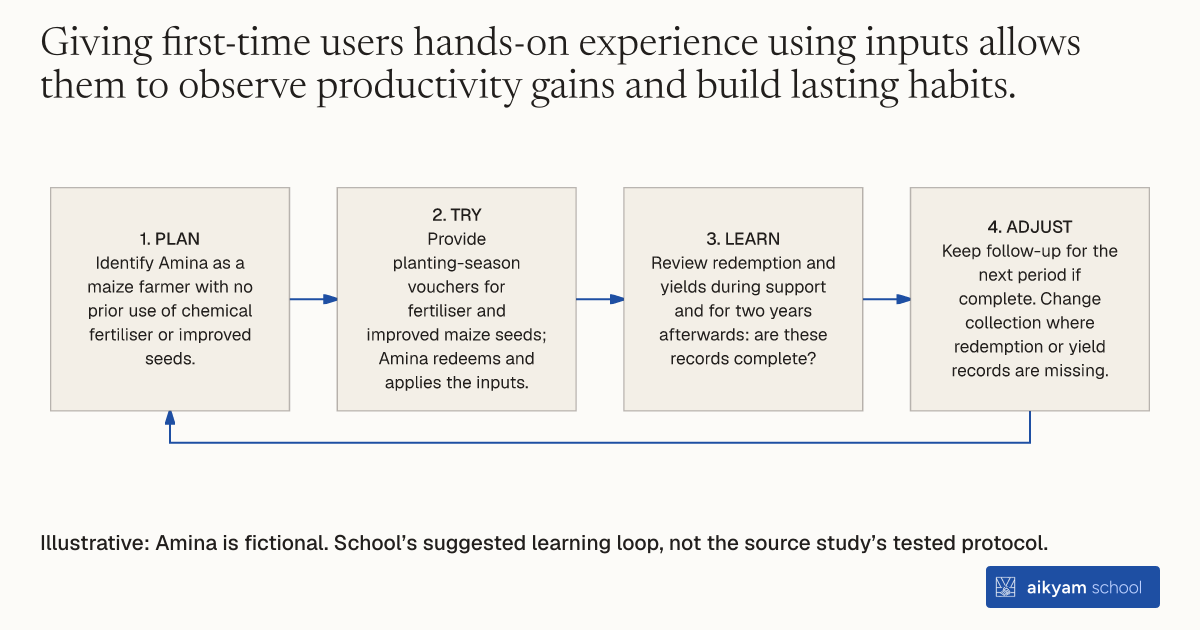
- Plan: Identify Amina as a maize farmer with no prior use of chemical fertiliser or improved seeds.
- Try: Provide planting-season vouchers for fertiliser and improved maize seeds; Amina redeems and applies the inputs.
- Learn: Review redemption and yields during support and for two years afterwards: are these records complete?
- Adjust: Keep follow-up for the next period if complete. Change collection where redemption or yield records are missing.
Illustrative: Amina is fictional. School’s suggested learning loop, not the source study’s tested protocol.
See source →School’s suggested, untested loop. Observe prior input experience, voucher use and later yields; this check does not establish lasting productivity gains.
How
When to use
Government input subsidy programs often fail to create lasting productivity gains after subsidies end. When subsidy vouchers target farmers with zero prior input experience, initial learning creates permanent changes in farming behavior. This approach helps first-time smallholder farmers establish long-term input adoption.
Target agricultural input subsidy vouchers exclusively to farmers with no prior experience using commercial inputs.
- Program administrators identify smallholder maize farmers who have never used chemical fertilizer or improved seeds.
- Government agencies disburse input subsidy vouchers for fertilizer and improved seeds to non-users during the planting season.
- First-time farmers redeem vouchers to acquire and apply fertilizer and improved maize seeds.
- Evaluators measure crop yields during the subsidy period and for two years after funding ends.
Example
An input subsidy program in Mozambique provided smallholder maize farmers with vouchers for fertilizer and improved seeds, where over two-thirds of participants had never used fertilizer before. Farmers increased crop yields during the program and maintained elevated yields for two years after the subsidy ended.
About the study
Participants
Smallholder maize farmers in Mozambique where over two-thirds had never used fertilizer.
Study Design
Randomized controlled trial evaluating multi-year crop yields and input adoption following a 2010-2011 input subsidy program for fertilizer and improved maize seeds.
Results
Fertilizer and seed vouchers raised maize yields during the program and sustained higher yield levels for two years after the program ended.