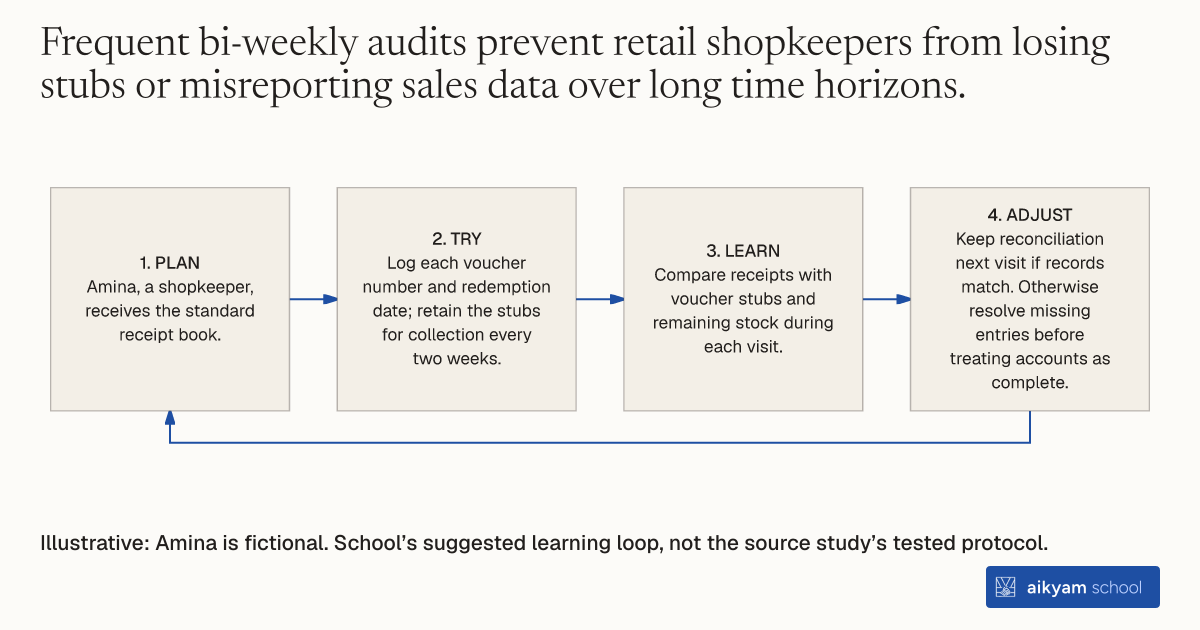
Try, learn and adjust
Check shop receipts against vouchers
- Plan: Amina, a shopkeeper, receives the standard receipt book.
- Try: Log each voucher number and redemption date; retain the stubs for collection every two weeks.
- Learn: Compare receipts with voucher stubs and remaining stock during each visit.
- Adjust: Keep reconciliation next visit if records match. Otherwise resolve missing entries before treating accounts as complete.
Illustrative: Amina is fictional. School’s suggested learning loop, not the source study’s tested protocol.
See source →School’s suggested, untested learning loop. Observe voucher numbers, redemption dates, stubs and stock every two weeks.
How
When to use
Health programs distributing subsidized products through third-party local merchants need to prevent fraud, track redemption rates, and verify that proper prices are charged. Establishing bi-weekly monitoring visits to inspect sales registers and collect voucher stubs ensures inventory accounting. This regular reporting mechanism allows program managers to audit retailer compliance in real time.
Collect standardized sales receipt logs and redeemed voucher stubs from local retail partners on a bi-weekly basis.
- Issue standardized receipt books to participating local retail shops at the start of product distribution.
- Instruct shopkeepers to enter the unique voucher identification number and exact redemption date for every transaction.
- Require shopkeepers to retain all collected physical voucher stubs alongside the receipt log entries.
- Send research field staff to visit each participating retail shop every two weeks.
- Reconcile recorded receipt log entries against collected physical voucher stubs and physical inventory levels during each bi-weekly visit.
Why it works
Regular physical inspection deters unauthorized sales and ensures proper accounting of cash proceeds collected from consumers.
Example
In Busia District, Western Kenya, field staff visited six participating local retailers every two weeks across Phase 1 and Phase 2 to collect redeemed voucher stubs and sales logs, confirming that 95 percent of redemptions were made directly by target household members.
About the study
Participants
6 local retail shops in rural Busia District, Western Kenya, handling voucher redemptions for 1,120 target households.
Study Design
Bi-weekly field visits to collect sales logs and voucher stubs, verifying customer identities and compliance with randomized price assignments across two study phases.
Results
Bi-weekly auditing verified that 95 percent of redeemed vouchers were presented directly by the intended recipient household, with 100 percent retailer compliance with assigned prices.