Try, learn and adjust
Check shop voucher redemptions
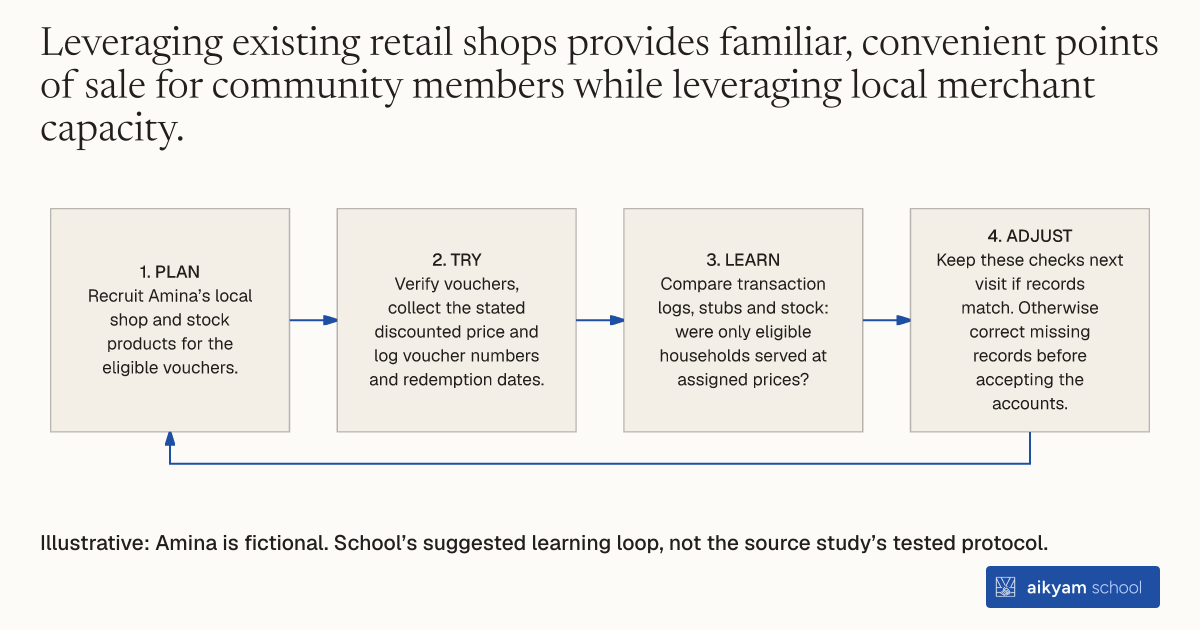
- Plan: Recruit Amina’s local shop and stock products for the eligible vouchers.
- Try: Verify vouchers, collect the stated discounted price and log voucher numbers and redemption dates.
- Learn: Compare transaction logs, stubs and stock: were only eligible households served at assigned prices?
- Adjust: Keep these checks next visit if records match. Otherwise correct missing records before accepting the accounts.
Illustrative: Amina is fictional. School’s suggested learning loop, not the source study’s tested protocol.
See source →School’s suggested, untested learning loop. Observe voucher eligibility, prices, dates and inventory; project goods must not be sold outside the sample.
How
When to use
Health programs need to distribute subsidized products through accessible commercial channels without establishing costly direct distribution infrastructure. Engaging existing village shopkeepers allows community members to acquire new health items in their local commercial environment. Partnering with local vendors also establishes standardized record-keeping to track redemption rates and secure inventory management.
Partner with local retail shops in target communities to stock health products, collect discount vouchers, and log sales transactions.
- Select and recruit one established local retail shop per village or study enumeration area.
- Supply each participating shopkeeper with a fixed stock of health products equal to the number of eligible vouchers issued in their community.
- Require retail shopkeepers to verify customer vouchers, collect the post-discount price, and collect the voucher stub upon redemption.
- Instruct shopkeepers to record the voucher identification number and exact redemption date in a standardized receipt book for every transaction.
- Prohibit shopkeepers from selling project-allocated products to non-study households or charging prices above the assigned voucher level.
Why it works
Standardized receipt books and voucher stub reconciliation ensure strict inventory control and prevent unauthorized sales outside target populations.
Example
In Western Kenya, researchers partnered with six local retail shops across six rural enumeration areas to manage redemption and sales logging for Olyset bed net discount vouchers issued to 1,120 households.
About the study
Participants
6 participating retail shops across six rural enumeration areas in Busia District, Western Kenya, serving 1,120 target households.
Study Design
Field experiment implementation where local shops held inventory, collected vouchers, recorded transaction details in standardized receipt books, and submitted logs bi-weekly.
Results
Retailers maintained 100 percent compliance with assigned customer prices, and 95 percent of all redeemed vouchers were presented directly by the intended recipient household.