Try, learn and adjust
Check factory safety committee activity
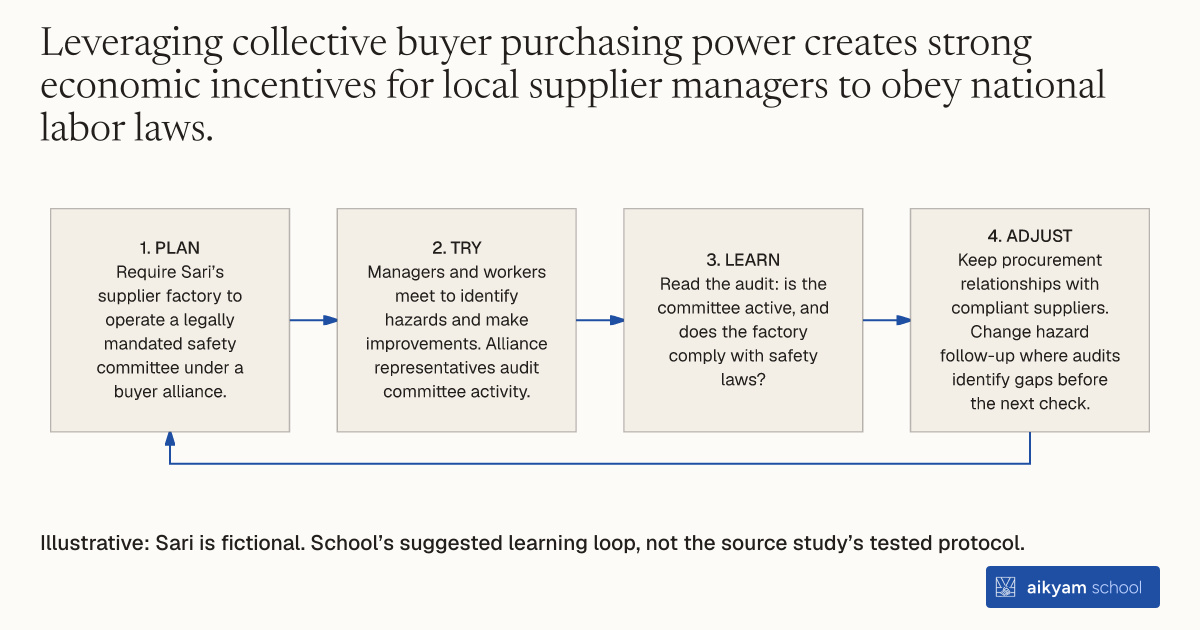
- Plan: Require Sari’s supplier factory to operate a legally mandated safety committee under a buyer alliance.
- Try: Managers and workers meet to identify hazards and make improvements. Alliance representatives audit committee activity.
- Learn: Read the audit: is the committee active, and does the factory comply with safety laws?
- Adjust: Keep procurement relationships with compliant suppliers. Change hazard follow-up where audits identify gaps before the next check.
Illustrative: Sari is fictional. School’s suggested learning loop, not the source study’s tested protocol.
See source →School’s suggested, untested loop. Observe committee activity, audits and compliance; this loop does not establish safety effects.
How
When to use
Local supplier factories in lower-income countries frequently fail to comply with national labor laws and workplace safety regulations. Domestic regulatory enforcement is often weak, leaving factory workers exposed to hazardous working conditions. Forming a coordinated alliance of international buyers forces supplier firms to establish active workplace safety committees.
Form an alliance of international buyers to enforce the implementation of legally mandated workplace safety committees in supplier factories.
- International corporate buyers in a manufacturing sector establish a joint alliance to enforce workplace safety standards.
- The buyer alliance requires all local supplier factories to implement legally mandated occupational safety and health committees.
- Alliance representatives conduct audits to verify that workplace safety committees operate actively in supplier facilities.
- Local factory managers and workers meet within safety committees to identify hazards and execute facility improvements.
- International buyers maintain procurement relationships only with local supplier factories that demonstrate full compliance with safety laws.
Why it works
Establishing joint safety committees gives factory workers a formal channel to identify hazards and improve workplace safety.
Example
In Bangladesh, multinational garment buyers formed an alliance that encouraged local supplier factories to implement legally required workplace safety committees, which increased compliance with labor laws and improved factory safety measures.
About the study
Participants
Ready-made garment supplier factories in Bangladesh.
Study Design
Randomized Controlled Trial (RCT) evaluating safety interventions across supplier facilities.
Results
Encouraging the implementation of workplace safety committees through a multinational buyer alliance increased supplier compliance with national labor laws and improved measures of factory safety.