Try, learn and adjust
Check radio retention for lottery eligibility
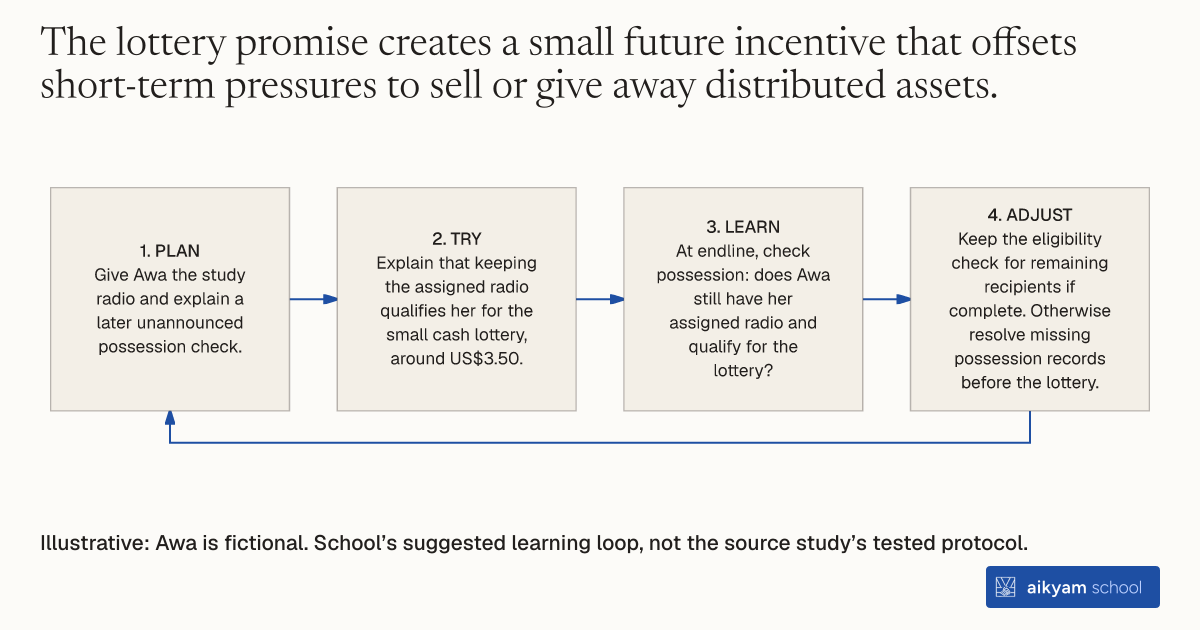
- Plan: Give Awa the study radio and explain a later unannounced possession check.
- Try: Explain that keeping the assigned radio qualifies her for the small cash lottery, around US$3.50.
- Learn: At endline, check possession: does Awa still have her assigned radio and qualify for the lottery?
- Adjust: Keep the eligibility check for remaining recipients if complete. Otherwise resolve missing possession records before the lottery.
Illustrative: Awa is fictional. School’s suggested learning loop, not the source study’s tested protocol.
See source →School’s suggested, untested learning loop. Observe radio possession and lottery eligibility. This check does not require repeating asset distribution.
How
When to use
In low-income field experiments or development programs, distributed physical assets face high risks of being sold or gifted over multi-year evaluation periods. Program evaluators want to maintain asset ownership among target recipients without providing large direct monetary transfers that alter household income. Offering eligibility in a future small cash prize lottery conditional on asset possession encourages recipients to retain the asset over long periods.
Offer access to a conditional cash lottery during asset distribution to incentivize target recipients to retain study equipment throughout the intervention.
- Distribute physical technology assets directly to primary target recipients during baseline field activities.
- Inform recipients during distribution that project staff will return at a future unannounced date to conduct endline verification audits.
- Announce that individuals who still possess their assigned equipment during the audit visit will qualify for a cash prize lottery.
- Set the conditional lottery prize value at a low monetary amount to prevent distortion of household income while providing sufficient retention motivation.
- Execute the cash lottery and distribute prize winnings to qualified asset retainers following final endline data collection.
Why it works
Because the prize is awarded via lottery at the end of the study, it maintains high asset retention rates while avoiding substantial income effects that could distort primary research outcomes.
Example
In Burkina Faso, field staff from Development Media International distributed 1,130 solar radios to women lacking radio access and announced a 3.5 US dollar conditional cash lottery for those who kept their devices. At the endline evaluation 1.5 years later, 95 percent of interviewed recipients still possessed their distributed radios, and 62 percent of those retained radios remained fully operational.
About the study
Participants
1,130 women across 1,397 off-grid rural households receiving solar radios in Burkina Faso.
Study Design
Randomized field distribution evaluation combined with conditional endline lottery auditing across 252 rural villages.
Results
Offering eligibility in a 3.5 US dollar cash lottery achieved a 95 percent asset retention rate among tracked recipients 1.5 years post-distribution.