Try, learn and adjust
Check conservation payments and food consumption
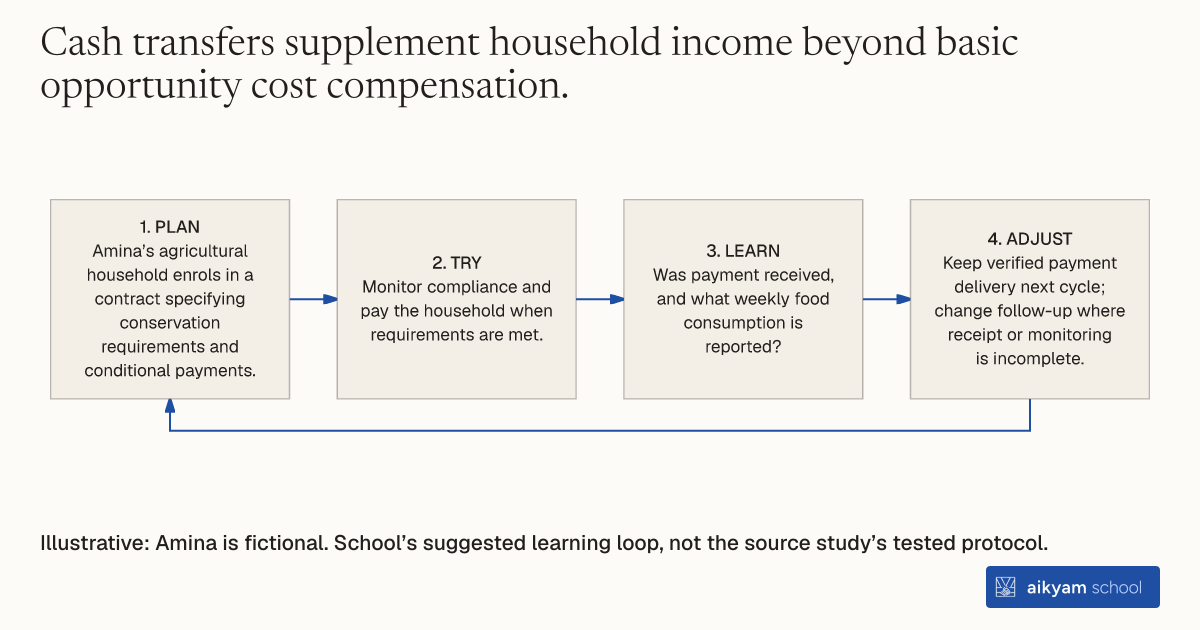
- Plan: Amina’s agricultural household enrols in a contract specifying conservation requirements and conditional payments.
- Try: Monitor compliance and pay the household when requirements are met.
- Learn: Was payment received, and what weekly food consumption is reported?
- Adjust: Keep verified payment delivery next cycle; change follow-up where receipt or monitoring is incomplete.
Illustrative: Amina is fictional. School’s suggested learning loop, not the source study’s tested protocol.
See source →School’s suggested learning loop, not a tested source procedure. Observe compliance, payment receipt and weekly food consumption; this check does not establish a causal food-security effect.
How
When to use
In low-income rural settings, environmental restrictions or sustainable practices can limit landholder income and worsen food insecurity. Conditional cash transfers compensate households for foregoing agricultural expansion or adopting eco-friendly practices. Providing these payments protects household consumption and reduces severe hunger among agricultural producers.
Pay conditional cash transfers to low-income agricultural households in exchange for meeting environmental conservation targets.
- Identify low-income agricultural households vulnerable to food insecurity in target conservation areas.
- Draft PES contracts that specify conditional cash payments in exchange for sustainable land management or forest protection.
- Enroll participating landholders into the conditional payment scheme.
- Verify landholder compliance with conservation requirements through periodic field monitoring.
- Disburse cash transfers directly to compliant households to support food consumption and household nutrition.
Why it works
This additional liquidity allows families to purchase food and smooth consumption during agricultural transition periods.
Example
A World Bank study in Burkina Faso evaluated PES conditional cash transfers for rural households, finding that payments increased weekly food consumption by 12 percent and made participants less likely to be severely food insecure.
About the study
Participants
Human agricultural households in rural Burkina Faso.
Study Design
Randomized Controlled Trial evaluating conditional cash transfers for ecosystem services on household food consumption and security.
Results
PES increased household weekly food consumption by 12 percent, making participants less likely to be severely food insecure.