Try, learn and adjust
Check the combined work and learning schedule
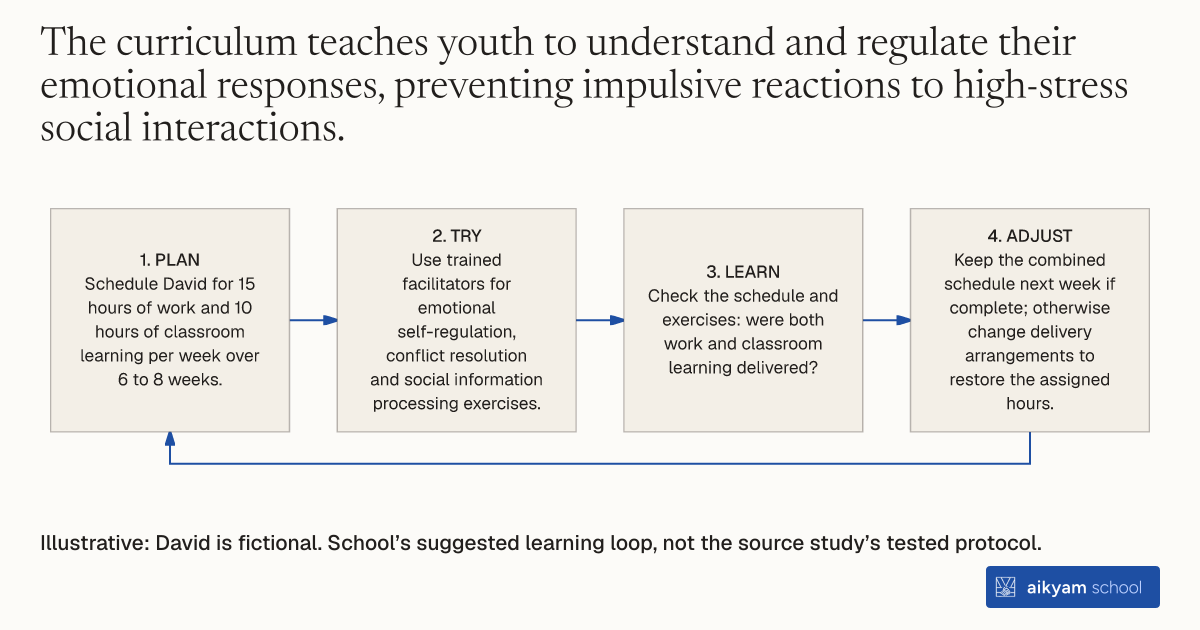
- Plan: Schedule David for 15 hours of work and 10 hours of classroom learning per week over 6 to 8 weeks.
- Try: Use trained facilitators for emotional self-regulation, conflict resolution and social information processing exercises.
- Learn: Check the schedule and exercises: were both work and classroom learning delivered?
- Adjust: Keep the combined schedule next week if complete; otherwise change delivery arrangements to restore the assigned hours.
Illustrative: David is fictional. School’s suggested learning loop, not the source study’s tested protocol.
See source →School’s suggested, untested learning loop. Observe work hours and learning exercises; the programme’s arrest results do not isolate the curriculum’s effect.
How
When to use
Disadvantaged youth in high-violence urban areas frequently experience emotionally charged conflicts that can escalate into violent arrests. Standard employment alone does not teach behavioral self-regulation skills. Incorporating specialized cognitive behavioral therapy principles into part-time summer jobs helps participants practice emotional self-control during critical adolescent years.
Integrate a social-emotional learning curriculum based on cognitive behavioral therapy into part-time summer youth employment programming.
- Assign youth to work 15 hours per week at minimum wage in subsidized summer job placements.
- Provide 10 hours per week of classroom social-emotional learning programming based on cognitive behavioral therapy principles.
- Train facilitators to guide participants through exercises in emotional self-regulation, conflict resolution, and social information processing.
- Schedule the combined 25-hour work and curriculum schedule across a 6 to 8 week summer program period.
Why it works
This recalibration of social information processing persists beyond the program, steering youth away from violent altercations.
Example
In Chicago, the One Summer Chicago Plus program provided half of its participants with 15 hours per week of minimum-wage work combined with 10 hours per week of social-emotional learning based on cognitive behavioral therapy over 6 to 8 weeks, reducing violent crime arrests by 35 percent over the following year.
About the study
Participants
5,216 male youth ages 16–22 in Chicago across 2012 and 2013 program cohorts (>90% free/reduced lunch, ~20–47% prior arrest history, residing in neighborhoods with ~20% unemployment and 33% household poverty).
Study Design
Randomized Controlled Trial (RCT) assigning applicants to treatment (summer job with or without CBT-based SEL curriculum) or control groups, tracking arrests through Chicago Police Department and Illinois State Police administrative records.
Results
OSC+ participation reduced violent crime arrests by 6.4 arrests per 100 youth over one year (a 35 percent reduction from a baseline of 18.3 arrests per 100 youth), with the majority of the reduction occurring after the summer program ended.