Try, learn and adjust
Check retirement savings choices reach payroll
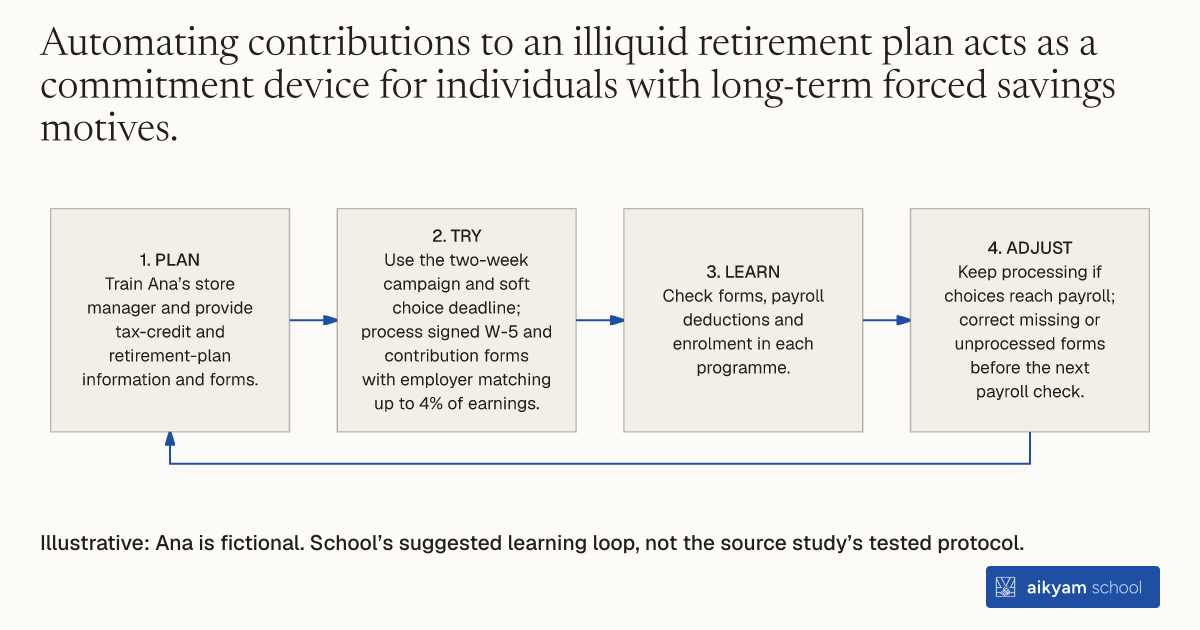
- Plan: Train Ana’s store manager and provide tax-credit and retirement-plan information and forms.
- Try: Use the two-week campaign and soft choice deadline; process signed W-5 and contribution forms with employer matching up to 4% of earnings.
- Learn: Check forms, payroll deductions and enrolment in each programme.
- Adjust: Keep processing if choices reach payroll; correct missing or unprocessed forms before the next payroll check.
Illustrative: Ana is fictional. School’s suggested learning loop, not the source study’s tested protocol.
See source →Observe signed choices, tax-credit participation, retirement enrolment and matching; do not promise unchanged take-home pay. School suggests this learning loop; it was not tested by the source.
How
When to use
Low-income workers often forgo periodic tax credit payments because small incremental amounts are spent immediately rather than saved. Channeling advance tax credit payments directly into employer-matched retirement accounts provides an automated commitment device for long-term savings. Organizations use this method to help low-wage employees accumulate assets without reducing net take-home pay relative to baseline.
Offer employees the option to automatically deposit incremental Advance EITC payouts into a company-matched 401(k) retirement savings account.
- Store managers receive training and reference tables outlining 401(k) contribution levels needed to offset Advance EITC payments.
- Managers distribute informational flyers, show instructional videos, and provide W-5 tax credit forms alongside 401(k) enrollment packets.
- Informational videos tell employees that extra weekly tax credit funds can be directed into their retirement plan.
- Employees complete both W-5 advance tax credit forms and 401(k) contribution election forms during a two-week workplace enrollment campaign.
- Store managers enforce a soft two-week active decision deadline for employees to hand in signed choice forms.
- Human resources processes payroll deductions and applies employer matching contributions up to four percent of earnings.
Why it works
Workers can save incremental cash transfers without lowering current baseline consumption because employer matching contributions increase overall compensation.
Example
A nationwide retail company introduced a combined Advance EITC and 401(k) outreach campaign across 6 store districts with 66 stores and 2,519 hourly workers, raising 401(k) participation among eligible workers from 44.7 percent to 50.1 percent.
About the study
Participants
The trial examined 2,519 hourly employees across 66 retail stores in 6 districts (77.4 percent female, 32.7 percent Hispanic, 19.8 percent Black, earning a median wage of \$7.26 to \$7.63 per hour).
Study Design
A randomized field experiment assigned store districts to receive combined Advance EITC and 401(k) promotional materials, manager training, and a two-week active decision deadline.
Results
The combined intervention increased 401(k) participation by 4.0 to 4.5 percentage points from a baseline of 46 percent among eligible workers, while Advance EITC participation increased by 0.7 to 0.8 percentage points.