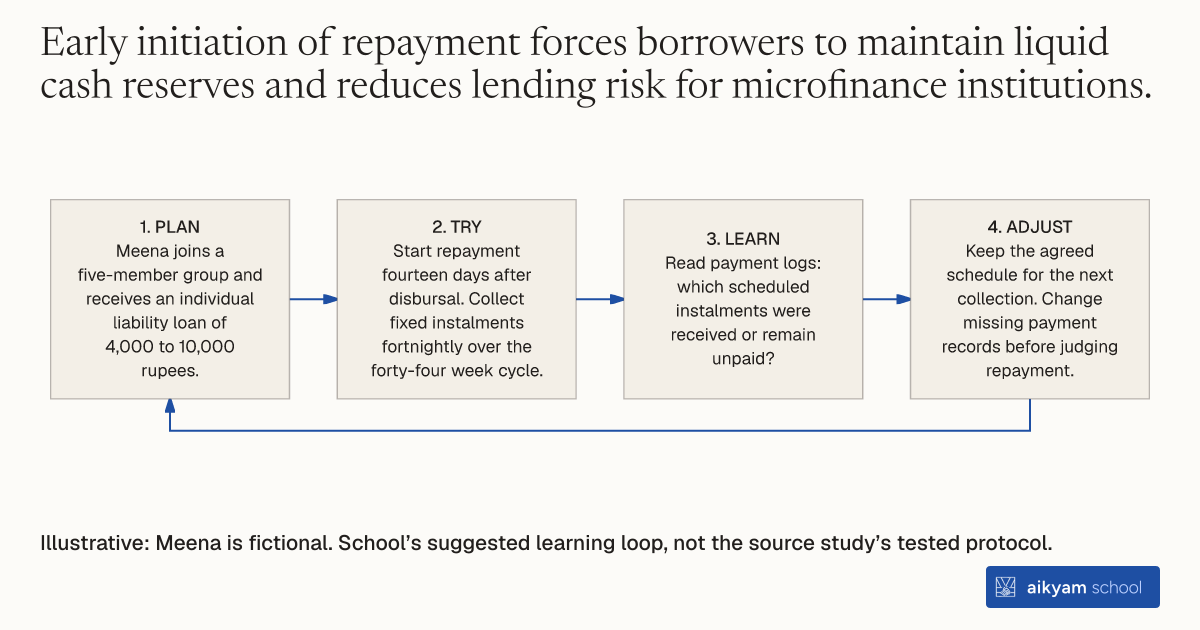
Try, learn and adjust
Check fortnightly repayment against the loan schedule
- Plan: Meena joins a five-member group and receives an individual liability loan of 4,000 to 10,000 rupees.
- Try: Start repayment fourteen days after disbursal. Collect fixed instalments fortnightly over the forty-four week cycle.
- Learn: Read payment logs: which scheduled instalments were received or remain unpaid?
- Adjust: Keep the agreed schedule for the next collection. Change missing payment records before judging repayment.
Illustrative: Meena is fictional. School’s suggested learning loop, not the source study’s tested protocol.
See source →Observe scheduled instalments and recorded payments; do not assume business gains. School suggests this learning loop; it is not the source’s tested procedure.
How
When to use
Low-income microfinance borrowers in urban credit markets need small loans to support household business activities. Lenders face high default risks when providing uncollateralized loans to poor entrepreneurs without formal financial records. Immediate regular repayment schedules limit lending risk by enforcing prompt financial discipline after loan disbursal.
Enforce immediate fortnightly repayment installments starting two weeks after disbursing individual liability microcredit loans.
- Form five-member borrower groups of low-income women through local microfinance institution branches.
- Disburse individual liability loans ranging from 4,000 to 10,000 rupees to each approved group member.
- Mandate the first fixed repayment installment exactly fourteen days after loan disbursal.
- Conduct biweekly group repayment meetings at a group member's home led by a loan officer.
- Collect fixed installment payments fortnightly over a forty-four week loan cycle until full principal and interest are recovered.
Why it works
Frequent installment meetings allow loan officers to monitor payments and reinforce habit formation among clients.
Example
Village Financial Services assigned 85 five-member loan groups of female clients in Kolkata to a standard microfinance contract with repayments starting two weeks post-disbursal. Clients invested 6,142.4 rupees in business activities, spent 557.2 rupees on home repairs, and achieved a repayment rate with a 1.65 percent default rate 24 weeks after loan due dates.
About the study
Participants
425 low-income female microfinance clients in 85 five-member loan groups across low-income neighborhoods in Kolkata, India.
Study Design
Field randomized controlled trial comparing a regular contract with a grace period contract, tracking repayment through administrative logs and panel surveys over 3 years.
Results
Regular contract clients invested 6,142.4 rupees in business expenditures, had a 2.0 percent new business creation rate, averaged 1,586.8 rupees in weekly business profits after three years, and maintained a default rate of 1.65 percent at 24 weeks and 2.12 percent at 52 weeks post-due date.