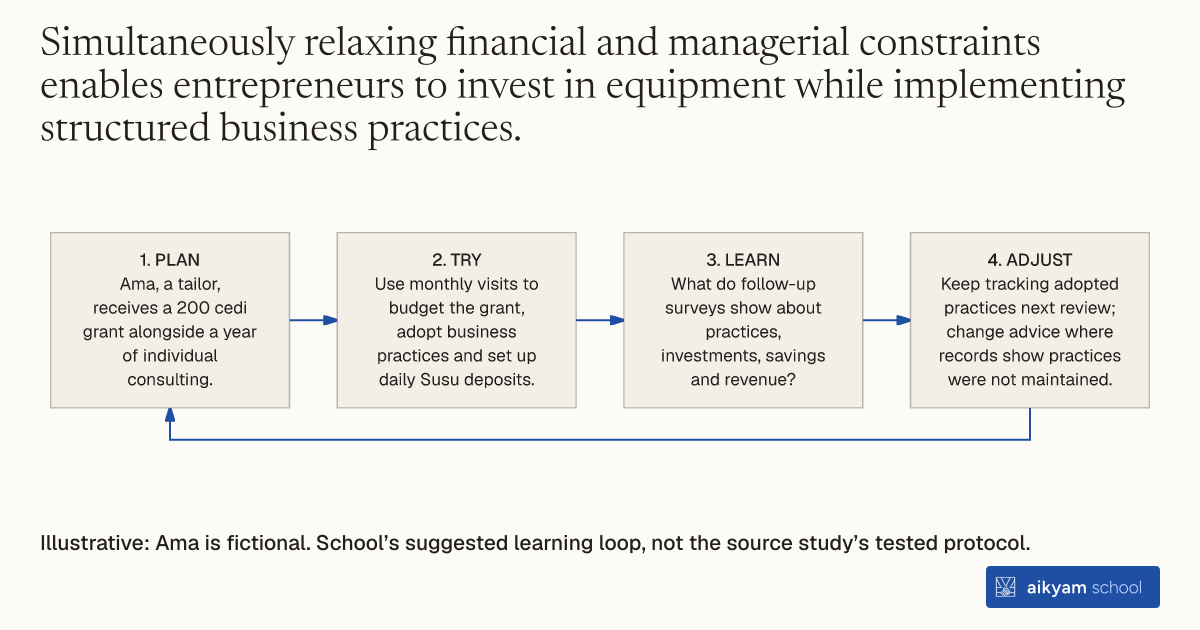
Try, learn and adjust
Check grant use and management practice adoption
- Plan: Ama, a tailor, receives a 200 cedi grant alongside a year of individual consulting.
- Try: Use monthly visits to budget the grant, adopt business practices and set up daily Susu deposits.
- Learn: What do follow-up surveys show about practices, investments, savings and revenue?
- Adjust: Keep tracking adopted practices next review; change advice where records show practices were not maintained.
Illustrative: Ama is fictional. School’s suggested learning loop, not the source study’s tested protocol.
See source →School’s suggested learning loop, not a tested source procedure. Observe practice adoption, investment, savings and revenue over two years; the source reports no long-term profit gains.
How
When to use
Microenterprise owners often face simultaneous financial and managerial constraints that limit business expansion. Combining cash grants with tailored advisory services tests whether capital transfers require managerial training to yield lasting profits. This approach serves small enterprise owners who need liquidity and operational guidance together.
Provide business capital transfers alongside individualized management advice to address financial and operational constraints together.
- Select small business owners through local enterprise surveys.
- Pair each owner with a professional business consultant for a one-year mentorship program.
- Deliver a cash grant of 200 cedis (~US \$133) directly to the owner's shop to double working capital.
- Conduct monthly consultant visits to help the owner budget the cash grant and adopt formal business practices.
- Guide the owner to set up daily doorstep micro-savings deposits to capture financial returns.
- Track practice adoption, business investments, and shop revenue across two years of follow-up surveys.
Example
Researchers provided a 200 cedi cash grant along with one year of Ernst & Young consulting to tailors in Accra, Ghana. Participants increased their monthly doorstep Susu savings from 18.6 cedis to 28.38 cedis, but their overall business profits showed no long-term gains compared to control tailors.
About the study
Participants
154 urban microenterprise tailors and seamstresses (36 assigned to receive both capital grants and consulting) in Accra, Ghana.
Study Design
Randomized Controlled Trial evaluating a combined 200 cedi cash grant and one year of tailored consulting against a control group across 8 survey waves over two years.
Results
Combined treatment raised monthly Susu savings by 16.63 cedis across pooled rounds (p < 0.10) and increased short-term practice adoption, but generated an average stated monthly income change of -1.82 cedis (p > 0.10) and failed to produce long-term enterprise growth.