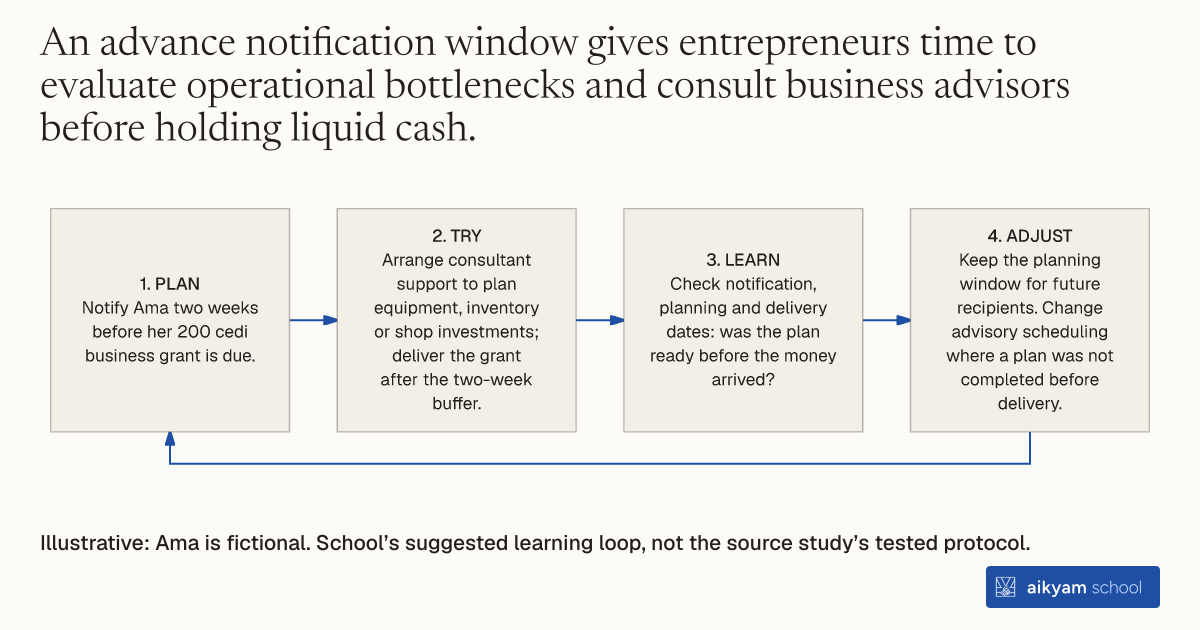
Try, learn and adjust
Check investment planning happens before grant delivery
- Plan: Notify Ama two weeks before her 200 cedi business grant is due.
- Try: Arrange consultant support to plan equipment, inventory or shop investments; deliver the grant after the two-week buffer.
- Learn: Check notification, planning and delivery dates: was the plan ready before the money arrived?
- Adjust: Keep the planning window for future recipients. Change advisory scheduling where a plan was not completed before delivery.
Illustrative: Ama is fictional. School’s suggested learning loop, not the source study’s tested protocol.
See source →School’s suggested, untested loop. Observe dates and plan completion. The source notes that scheduling prevented some plans from being completed before payment.
How
When to use
Microenterprise owners receiving cash grants often spend unallocated funds on immediate personal consumption or unplanned purchases. Providing an advance notification window before cash disbursement allows entrepreneurs time to consult advisors and formulate structured business investment plans. This method serves development programs distributing non-repayable capital transfers to small business owners.
Establish a two week advance notification window prior to disbursing business cash grants to facilitate investment planning.
- Select microenterprise grant recipients following randomized allocation procedures.
- Formally notify selected business owners two weeks prior to the scheduled cash distribution date.
- Schedule advisory sessions between business consultants and grant recipients during the two week buffer window.
- Guide the entrepreneur to identify specific high return equipment, inventory, or shop improvements.
- Formulate a written capital utilization plan detailing the planned cash allocations.
- Deliver the full cash grant directly to the shop owner at the conclusion of the two week notification buffer.
Why it works
Pre-planning reduces impulse spending and encourages targeted capital investments in business assets.
Example
Researchers built a two week buffer between grant notification and cash delivery for tailors receiving 200 cedi grants in Accra, Ghana, allowing consultants time to help tailors plan investments. Capital grant recipients spent 179 cedis more on baseline targeted assets than control group tailors at two months post grant.
About the study
Participants
154 urban microenterprise tailors and seamstresses in Accra, Ghana.
Study Design
Randomized Controlled Trial incorporating a two week pre-distribution planning buffer for 75 cash grant recipients across 8 survey waves over two years.
Results
Capital recipients receiving advance notification invested 179 cedis more in target assets in Round 3 (p < 0.10) and 326 cedis in net financial asset flows in Round 6 (p < 0.01), though scheduling availability prevented some tailors from completing plans prior to cash arrival.