Try, learn and adjust
Check maternity savings are recorded and available
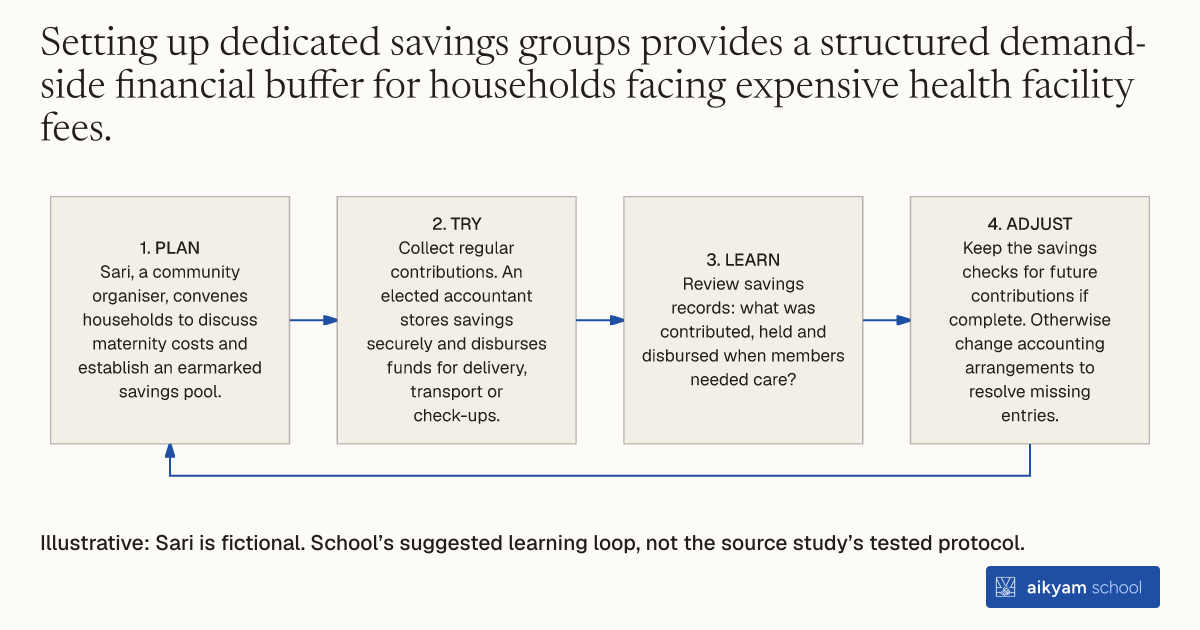
- Plan: Sari, a community organiser, convenes households to discuss maternity costs and establish an earmarked savings pool.
- Try: Collect regular contributions. An elected accountant stores savings securely and disburses funds for delivery, transport or check-ups.
- Learn: Review savings records: what was contributed, held and disbursed when members needed care?
- Adjust: Keep the savings checks for future contributions if complete. Otherwise change accounting arrangements to resolve missing entries.
Illustrative: Sari is fictional. School’s suggested learning loop, not the source study’s tested protocol.
See source →School's suggested, untested loop: observe contributions, stored savings and disbursements; no care or health outcome is assumed.
How
When to use
Rural expectant mothers and families face high healthcare costs that prevent them from seeking facility-based maternal care. Local community organizers need a demand-side financial mechanism to help households prepare for medical expenses. Organizers establish village savings pools to reduce financial barriers to antenatal, delivery, and postnatal services.
Form a community maternity savings group to help pregnant women and families save funds for delivery and healthcare costs.
- Recruited community representatives convene village households to discuss expected maternal and newborn healthcare expenses.
- Establish a designated community savings pool, such as a local Tabulin group, specifically earmarked for maternity costs.
- Collect regular monetary contributions from participating pregnant women, partners, and community members.
- Store collected savings securely with an elected community group accountant or village financial manager.
- Disburse accumulated funds to pregnant group members when they require care for delivery, emergency transport, or clinical check-ups.
Why it works
Pooling community funds ensures that expectant mothers have liquid cash available when labor begins or medical emergencies arise.
Example
In rural intervention villages across Indonesia and Tanzania, community representatives created savings groups like Tabulin in Indonesia, with 9.0% of all intervention villages designing savings pools to help families afford delivery expenses.
About the study
Participants
200 rural treatment villages across two regions in Indonesia (100 villages) and two regions in Tanzania (100 villages).
Study Design
Randomized controlled trial evaluating a non-prescriptive civic deliberation initiative, tracking social action plans and goal completion over a 90-day intervention period.
Results
Savings pools represented 15.8% of actions within the increased ability to pay pathway (14.1% in Indonesia and 18.0% in Tanzania), with 45.0% of all intervention communities designing at least one action to increase ability to pay.