Research steps
Randomise community norm information
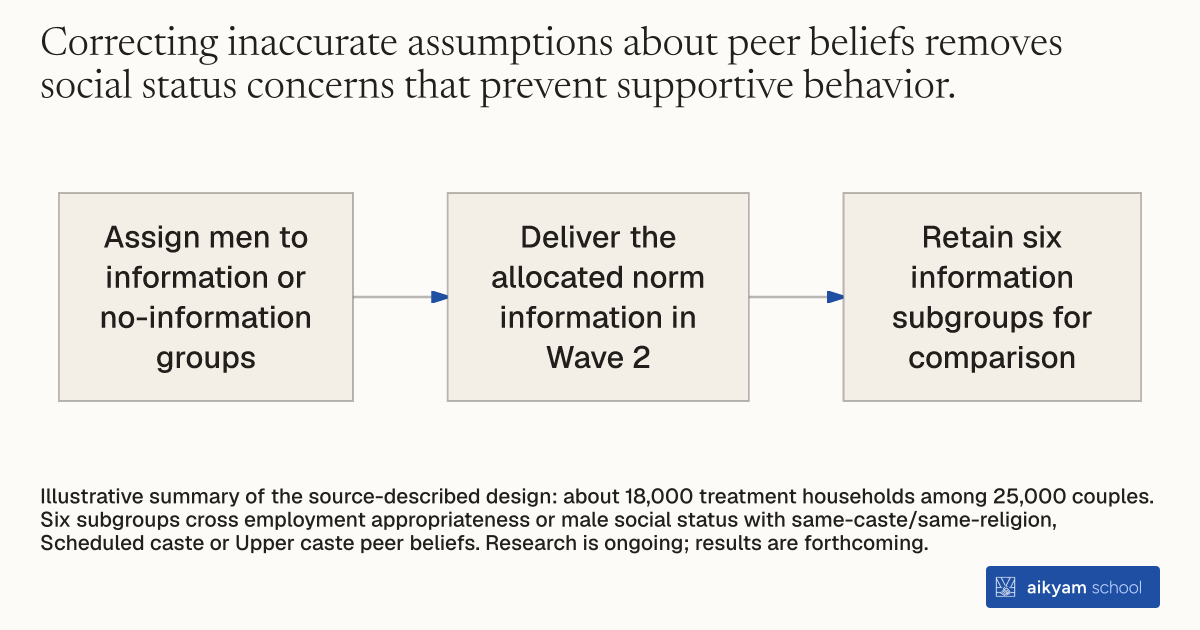
- Assign men to information or no-information groups
- Deliver the allocated norm information in Wave 2
- Retain six information subgroups for comparison
Illustrative summary of the source-described design: about 18,000 treatment households among 25,000 couples. Six subgroups cross employment appropriateness or male social status with same-caste/same-religion, Scheduled caste or Upper caste peer beliefs. Research is ongoing; results are forthcoming.
See source →How
When to use
In societies with low female labor participation, men often overestimate how conservative their peers are regarding women working outside the home. This misperception prevents husbands from allowing their wives to join the workforce even when private attitudes are supportive. This method provides targeted information about community norms to correct misperceptions for married men.
Deliver accurate community norm data to married men across distinct sub-group categories to correct peer belief misperceptions.
- Field staff randomly assign married men to treatment groups or a comparison group receiving no information.
- Field staff present men in one subset with accurate community data showing what same-caste, same-religion men in their state believe about female employment appropriateness.
- Field staff inform a second subset about the beliefs of Scheduled caste men regarding female employment appropriateness.
- Field staff share data with a third subset regarding Upper caste men's beliefs about female employment appropriateness.
- Field staff provide subsets four through six with corresponding data on whether female employment decreases a man's social status among same-caste, Scheduled caste, and Upper caste peers.
- Field staff conduct these information deliveries across approximately 18,000 households in the treatment arm.
Why it works
When men learn that community norms are more supportive than expected, they align their decisions with their actual private beliefs.
Example
Researchers in India provided accurate norm information to married men in about 18,000 households across 200 districts, sharing specific peer belief data about same-caste, Scheduled caste, and Upper caste men.
About the study
Participants
About 18,000 households in the treatment group out of 25,000 married couples in 200 districts across urban and rural India.
Study Design
Randomized controlled trial dividing households into six targeted information treatment sub-groups and one comparison group during Wave 2.
Results
Research ongoing; results forthcoming.