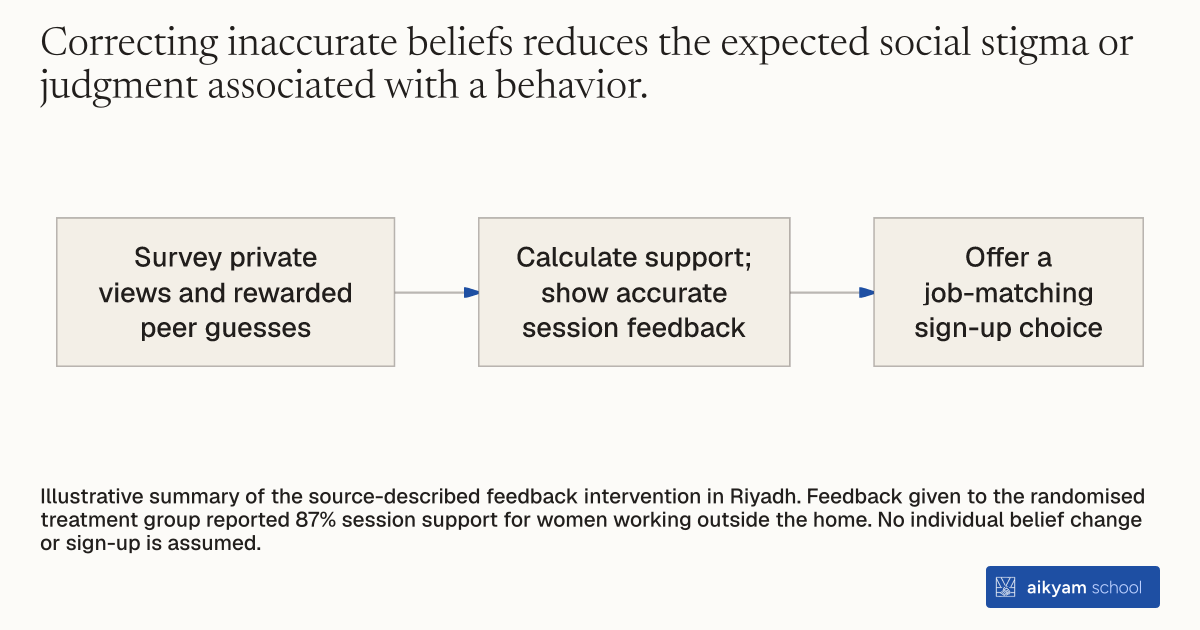
Research steps
Show measured peer support after private answers
- Survey private views and rewarded peer guesses
- Calculate support; show accurate session feedback
- Offer a job-matching sign-up choice
Illustrative summary of the source-described feedback intervention in Riyadh. Feedback given to the randomised treatment group reported 87% session support for women working outside the home. No individual belief change or sign-up is assumed.
See source →How
When to use
Communities often experience pluralistic ignorance where most people hold a private opinion but wrongly believe their peers oppose it. This misperception causes individuals to act against their true preferences out of fear of social stigma. Providing factual feedback on peer beliefs corrects these misperceptions and removes social barriers to participation.
Correct misperceived social norms by surveying target community members anonymously and sharing accurate group feedback.
- Recruiter gathers participants from a shared local social network or geographical area.
- Administrator collects individual private opinions and incentivised guesses about peer opinions using anonymous survey software on mobile devices.
- Facilitator calculates the true proportion of participants holding the supportive private view across the session.
- Administrator displays feedback charts embedded in the survey showing the true percentage of session participants agreeing with the statement.
- Organization presents participants with an incentivised choice related to the target behavior, such as signing up for a job-matching service.
Why it works
When people realize their peers privately support the behavior, social image concerns no longer prevent them from acting on their true preferences.
Example
In Riyadh, Saudi Arabia, researchers surveyed 500 married men aged 18 to 35 in 17 neighborhood sessions. When given feedback that 87% of session participants privately supported women working outside the home, husbands' sign-up rate for a job-matching application for their wives increased from 23.5% in the control group to 32.0% in the treatment group.
About the study
Participants
500 married Saudi males aged 18 to 35 with at least some college education and smartphone access, recruited from different neighborhoods across Riyadh.
Study Design
Randomized controlled trial (RCT) with individual-level randomization based on trailing phone digits across 17 session groups of 30 participants sharing local social networks.
Results
Information feedback increased job-matching application sign-up rates by 8.5 percentage points (from 23.5% to 32.0%, a 36.4% increase). For men who originally underestimated peer support, sign-up rates increased by 12.2 percentage points (from 21.4% to 33.5%, a 57% increase).